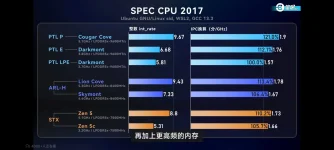
Panther Lake flexes real IPC gains, putting Intel ahead of AMD in per-clock efficiency, at least on paper benchmarks.
What got tested
What got tested
- Intel Panther Lake cores went under the microscope.
- Focus stayed on IPC, not raw clocks.
- Comparison landed against AMD Strix Halo.
- An independent tester posted results on Bilibili.
- Benchmarks used SPEC CPU 2017.
- Integer performance took center stage.
- The LPDDR5 memory platform was used.
- WSL 2 handled the environment.
- A mix of Intel and AMD core designs tested.
- Cougar Cove represents Panther Lake P-Cores.
- Darkmont covers the E-Core side.
- Both stem from Intel’s 18A platform.
- Zen 5 and Zen 5c served as rivals.
- Both come from Strix Halo.
- Results normalized for IPC per GHz.
- Cougar Cove shows about ten percent higher IPC.
- Darkmont lands roughly six percent ahead.
- Gains measured against Zen 5 designs.
- Raw throughput favors clock speed.
- IPC per GHz isolates architecture efficiency.
- Metric highlights design improvements.
- Panther Lake mixes P, E, and LP-E cores.
- Design targets performance with efficiency.
- IPC edge signals Intel’s architectural rebound.