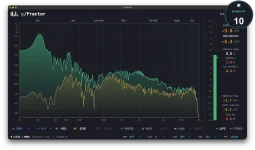
Growl Audio pushed gFractor 1.2.3 Beta to their preview channel with significant metering upgrades. Loudness readouts now toggle between absolute LUFS and relative LU values via new pills, while a draggable TARGET badge adjusts in 0.5 LU increments.
Crest factor displays peak-to-RMS ratios over matching 3-second windows alongside reset-on-play transport syncing. Stereo correlation charts resolve down to 31.5 Hz using 8192-point FFT analysis for precise per-octave band plotting across the frequency spectrum.
Scope cursors track pointer position with dB labels relative to lane zero lines. Sidechain signals appear as ghost envelopes beneath main curves, enabling visual gain reduction monitoring directly within the oscilloscope display during mixing sessions.
Users export branded 2x PNG screenshots through header camera controls or E shortcuts. Meter preferences gained a dedicated tab housing target levels, LUFS ranges, and transport reset toggles separate from display settings.
Empty octave bands correctly show zero correlation instead of false noise readings. Saved target curves no longer read past data boundaries when reloaded at smaller FFT sizes, while GHOST pill states persist through editor reopening cycles.
Crest factor displays peak-to-RMS ratios over matching 3-second windows alongside reset-on-play transport syncing. Stereo correlation charts resolve down to 31.5 Hz using 8192-point FFT analysis for precise per-octave band plotting across the frequency spectrum.
Scope cursors track pointer position with dB labels relative to lane zero lines. Sidechain signals appear as ghost envelopes beneath main curves, enabling visual gain reduction monitoring directly within the oscilloscope display during mixing sessions.
Users export branded 2x PNG screenshots through header camera controls or E shortcuts. Meter preferences gained a dedicated tab housing target levels, LUFS ranges, and transport reset toggles separate from display settings.
Empty octave bands correctly show zero correlation instead of false noise readings. Saved target curves no longer read past data boundaries when reloaded at smaller FFT sizes, while GHOST pill states persist through editor reopening cycles.