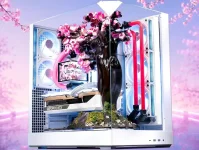
Aftershock’s Cherry Bloom PC uses 70 hand-painted titanium-alloy blossoms that physically open as the computer warms and close again as it cools. The Aftershock Cherry Bloom RTX 5080 PC does this without electric motors driving each flower, so the metal itself becomes part of the moving mechanism.
The plain answer to what a shape memory alloy is starts inside its crystal structure. These metals can switch between solid phases as temperature or stress changes, and a reversible austenite-to-martensite phase transformation lets a trained part recover a previously set shape instead of behaving like ordinary bent sheet metal.
A Nitinol shape memory alloy made from nickel and titanium is the best-known example, but Aftershock only describes its blossoms as a special temperature-reactive titanium alloy. It has not publicly identified the exact composition, heat treatment, training process, or shape memory alloy transition temperature used in Cherry Bloom, so calling the petals Nitinol would go beyond the disclosed information.
A shape memory alloy phase transformation occurs across a temperature range rather than at one magic number. Engineers normally describe four points, with martensite start and finish temperatures on cooling and austenite start and finish temperatures on heating. Hysteresis in shape memory alloys also means the heating and cooling transitions do not have to happen at identical temperatures, which helps explain why a moving metal part can have separate opening and closing behavior.
A two-way shape memory alloy can be trained to adopt one geometry when cooler and another when warmer. Plenty of shape memory alloy actuator designs instead use a one-way material against a spring, preload, gravity, or another restoring force. Cherry Bloom visibly returns to its resting state after cooling, but Aftershock has not disclosed enough mechanical detail to tell which arrangement its petals use.
The petal temperature is not necessarily the same as the GPU temperature shown in monitoring software. Airflow, distance from the graphics card, nearby coolant tubing, petal thickness, mounting points, case intake temperature, and fan speed can all change how quickly an individual flower heats or cools. A PC cooling system moves heat through several stages, so a sensor reading on one chip cannot fully describe the temperature of a decorative part elsewhere in the case.
Fan control adds another wrinkle. Modern graphics cards may change fan behavior according to several thermal and power conditions, and GPU fan-stop behavior can depend on more than core temperature. In Cherry Bloom, a more aggressive fan curve could plausibly slow the rise of local case temperature or speed the cooldown, while warmer room air could do the opposite. The exact effect would need measurements on the finished system.
Engineered SMA devices usually make actuation predictable by controlling temperature, load, geometry, and cycling conditions. A gaming PC is a messier thermal environment because workloads jump around and cooling reacts continuously. The contrast is obvious beside an RTX 5080 built specifically around aggressive liquid cooling, where the design goal is to remove heat quickly rather than make it visible.
Shape memory alloy cooling is especially relevant because heating can be quick while passive cooling may take longer. Thin petals exposed to moving case air should respond differently from a thick actuator buried in an insulated assembly, and repeated thermal cycling can gradually alter functional behavior in some alloys. The flowers therefore work less like electronic pixels and more like small thermomechanical components whose timing depends on their local environment.
Shape memory alloy applications usually hide this behavior inside valves, medical devices, aerospace mechanisms, springs, or compact actuators. Cherry Bloom does the reverse by putting the material response where you can watch it, using the PC’s changing thermal state as the control input while the alloy supplies the motion.
The plain answer to what a shape memory alloy is starts inside its crystal structure. These metals can switch between solid phases as temperature or stress changes, and a reversible austenite-to-martensite phase transformation lets a trained part recover a previously set shape instead of behaving like ordinary bent sheet metal.
Heat changes the crystal structure
The working principle of a shape memory alloy is not simple thermal expansion. In the common thermal shape-memory effect, lower-temperature martensite can be deformed, then heating drives the material toward higher-temperature austenite and the part moves back toward its trained geometry. Cooling reverses the crystal phase, although the visible motion on cooling depends on how the component has been trained and mechanically loaded.A Nitinol shape memory alloy made from nickel and titanium is the best-known example, but Aftershock only describes its blossoms as a special temperature-reactive titanium alloy. It has not publicly identified the exact composition, heat treatment, training process, or shape memory alloy transition temperature used in Cherry Bloom, so calling the petals Nitinol would go beyond the disclosed information.
A shape memory alloy phase transformation occurs across a temperature range rather than at one magic number. Engineers normally describe four points, with martensite start and finish temperatures on cooling and austenite start and finish temperatures on heating. Hysteresis in shape memory alloys also means the heating and cooling transitions do not have to happen at identical temperatures, which helps explain why a moving metal part can have separate opening and closing behavior.
A two-way shape memory alloy can be trained to adopt one geometry when cooler and another when warmer. Plenty of shape memory alloy actuator designs instead use a one-way material against a spring, preload, gravity, or another restoring force. Cherry Bloom visibly returns to its resting state after cooling, but Aftershock has not disclosed enough mechanical detail to tell which arrangement its petals use.
PC thermals become part of the mechanism
A thin shape memory alloy wire can turn heat into motion because the phase change produces usable strain and force. Cherry Bloom applies the same broad idea to decorative metal petals, except its thermal source is the computer itself. Aftershock says system heat under gaming load opens the blossoms, turning waste heat into a physical display rather than sending every bit of it straight out of the chassis.The petal temperature is not necessarily the same as the GPU temperature shown in monitoring software. Airflow, distance from the graphics card, nearby coolant tubing, petal thickness, mounting points, case intake temperature, and fan speed can all change how quickly an individual flower heats or cools. A PC cooling system moves heat through several stages, so a sensor reading on one chip cannot fully describe the temperature of a decorative part elsewhere in the case.
Fan control adds another wrinkle. Modern graphics cards may change fan behavior according to several thermal and power conditions, and GPU fan-stop behavior can depend on more than core temperature. In Cherry Bloom, a more aggressive fan curve could plausibly slow the rise of local case temperature or speed the cooldown, while warmer room air could do the opposite. The exact effect would need measurements on the finished system.
Engineered SMA devices usually make actuation predictable by controlling temperature, load, geometry, and cycling conditions. A gaming PC is a messier thermal environment because workloads jump around and cooling reacts continuously. The contrast is obvious beside an RTX 5080 built specifically around aggressive liquid cooling, where the design goal is to remove heat quickly rather than make it visible.
The missing details matter
The key shape memory alloy characteristics for a moving petal include transformation range, recoverable strain, generated force, cycle life, response time, and the mechanical bias that returns it to rest. None of those figures are published for Cherry Bloom. Without them, it is possible to explain the mechanism class confidently but not the exact opening temperature, closing temperature, actuation force, or expected lifetime of each blossom.Shape memory alloy cooling is especially relevant because heating can be quick while passive cooling may take longer. Thin petals exposed to moving case air should respond differently from a thick actuator buried in an insulated assembly, and repeated thermal cycling can gradually alter functional behavior in some alloys. The flowers therefore work less like electronic pixels and more like small thermomechanical components whose timing depends on their local environment.
Shape memory alloy applications usually hide this behavior inside valves, medical devices, aerospace mechanisms, springs, or compact actuators. Cherry Bloom does the reverse by putting the material response where you can watch it, using the PC’s changing thermal state as the control input while the alloy supplies the motion.