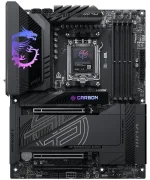
A quiet motherboard refresh swaps flashy redesigns for firmware headroom and tuning flexibility that mainly matters to hardcore tweakers.
What the MAX refresh actually changes
What the MAX refresh actually changes
- MSI rolled out the MPG X870E CARBON MAX WIFI.
- Core layout and visuals stayed basically the same.
- BIOS storage jumped to a much larger chip.
- Added a standalone clock generator for finer control.
- Bigger firmware space helps long-term CPU support.
- Leaves room for memory training and security updates.
- Clock generator favors base clock experimentation.
- Targets users pushing past casual overclocks.
- MPG X870E CARBON MAX WIFI sticks with AM5.
- Uses an 8-layer PCB and heavy-duty power delivery.
- VRM cooling leans on heatpipes and armor coverage.
- Built as a high-end X870E-class board.
- Four DDR5 UDIMM slots run in 2DPC mode.
- Claimed speeds reach 8400 plus MT per second.
- Results depend on CPU IMC quality.
- BIOS profiles and DIMMs make or break outcomes.
- Three full-length expansion slots are available.
- Two CPU-linked slots run at PCIe 5.0.
- Lane sharing affects GPUs and Gen5 storage.
- Third slot drops to chipset-fed PCIe 4.0.
- Four M.2 sockets handle mixed generations.
- Two CPU-direct PCIe 5.0 x4 slots lead.
- Two chipset PCIe 4.0 x4 slots follow.
- Four SATA ports cover legacy drives.
- Dual Ethernet covers 5GbE and 2.5GbE.
- Wi-Fi 7 supports wide 320 MHz channels.
- USB lineup emphasizes 40Gbps Type C.
- HDMI 2.1 FRL and full audio outputs included.
- MPG X870E CARBON MAX WIFI plays it safe.
- Feels like continuity rather than reinvention.
- MAX branding targets firmware longevity.
- Appeals most to serious tuners, not casual builders.