Palit first ran its Japanese mascot contest in July 2021, years before RiTONA appeared on a globally promoted graphics card. The winning character was announced on August 18, a date Palit treats as her birthday, but she still did not have an official name.
Palit opened a separate naming contest that December, then settled on Nijino RiTONA in February 2022. Voice actor auditions followed in May, with Palit announcing the result on June 8. The whole thing unfolded in public instead of arriving as a finished marketing package.
Palit's original Japanese character page framed RiTONA as a symbol of the company's creativity and passion, using the image of a palette where colors mix. Her clothing leaned into futurism, speed, innovation, and glory, so the current version did not start from a blank sheet.
Separating the design from the naming contest is a small detail, but it shows what fans were actually helping choose. The visual character existed before the finished identity did. August 18, 2021 works as RiTONA's creation date on Palit's timeline, while February 12, 2022 marks the naming decision.
Academic work on how anthropomorphic branding changes product response also makes the wider idea less fluffy than it sounds. Human-like brand characters can influence how products are judged, although the effect changes with context and is not some automatic cheat code. RiTONA is a clean example of a hardware company trying to give a technical brand an actual personality without pretending the mascot is the product.
The Japanese version also had a more specific identity than the generic phrase "anime mascot" suggests. Palit used the name Nijino RiTONA, kept green and yellow as core colors, and built her look around forward-motion tech imagery rather than fantasy alone. It was very PC-hardware-brain, just filtered through character design.
The most useful new detail is the cape. Palit says its crystalline styling comes from the GameRock graphics card family, so the character now borrows directly from one of the company's established hardware designs. Her wand keeps the brighter fantasy side alive, while the cape drags the look back toward PC components.
The global page changes the scale by presenting RiTONA as Palit's digital brand ambassador and maintaining character wallpapers plus a cosplay gallery around her. The 2026 push is broader than a one-card collaboration, even though the graphics card gives the redesign its clearest physical form.
Gelo also became part of the package as a crystal, cat-shaped slime with a jelly-like appearance, playful personality, and affection for gaming on GeForce cards. It sounds ridiculous on paper, which is partly why it feels more deliberate than tossing a random pet next to a mascot and calling the job done.
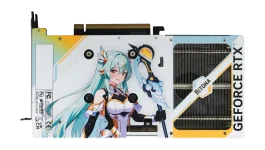
Palit carried the old color identity onto the card instead of covering a normal black model with one printed image. The shroud is white with green and yellow accents, the backplate carries full-color RiTONA artwork, and the side lighting fits the newer crystal-heavy visual style. Waterproof character stickers in the box push the same idea into the rest of a build.
Even the newer costume makes more sense once the card is sitting next to it. The GameRock-inspired cape, crystalline Gelo design, ARGB lighting, and bright backplate all use the same visual vocabulary, so the 2026 version feels designed for hardware from the start. RiTONA began as a fan-shaped Japanese mascot in 2021, but the current design is built to live on a graphics card rather than merely advertise one.
Palit opened a separate naming contest that December, then settled on Nijino RiTONA in February 2022. Voice actor auditions followed in May, with Palit announcing the result on June 8. The whole thing unfolded in public instead of arriving as a finished marketing package.
Palit's original Japanese character page framed RiTONA as a symbol of the company's creativity and passion, using the image of a palette where colors mix. Her clothing leaned into futurism, speed, innovation, and glory, so the current version did not start from a blank sheet.
RiTONA came from a community process before the hardware
Brand mascots are easy to dismiss as a logo with a face, but RiTONA had a slightly stranger route. Fans were pulled into the character contest first, then the naming process, and later Palit searched publicly for a voice. By the time the name was fixed, she already had a small history attached to her.Separating the design from the naming contest is a small detail, but it shows what fans were actually helping choose. The visual character existed before the finished identity did. August 18, 2021 works as RiTONA's creation date on Palit's timeline, while February 12, 2022 marks the naming decision.
Academic work on how anthropomorphic branding changes product response also makes the wider idea less fluffy than it sounds. Human-like brand characters can influence how products are judged, although the effect changes with context and is not some automatic cheat code. RiTONA is a clean example of a hardware company trying to give a technical brand an actual personality without pretending the mascot is the product.
The Japanese version also had a more specific identity than the generic phrase "anime mascot" suggests. Palit used the name Nijino RiTONA, kept green and yellow as core colors, and built her look around forward-motion tech imagery rather than fantasy alone. It was very PC-hardware-brain, just filtered through character design.
The global redesign keeps the old colors but grows up
The version Palit pushed globally in 2026 is clearly supposed to look older and more self-assured. The green hair stayed, PALIT yellow stayed, and the company still describes her as smart, spirited, and playful. The costume changed enough to make the redesign obvious without making her look like a completely different character.The most useful new detail is the cape. Palit says its crystalline styling comes from the GameRock graphics card family, so the character now borrows directly from one of the company's established hardware designs. Her wand keeps the brighter fantasy side alive, while the cape drags the look back toward PC components.
The global page changes the scale by presenting RiTONA as Palit's digital brand ambassador and maintaining character wallpapers plus a cosplay gallery around her. The 2026 push is broader than a one-card collaboration, even though the graphics card gives the redesign its clearest physical form.
Gelo also became part of the package as a crystal, cat-shaped slime with a jelly-like appearance, playful personality, and affection for gaming on GeForce cards. It sounds ridiculous on paper, which is partly why it feels more deliberate than tossing a random pet next to a mascot and calling the job done.
The RTX 5060 Ti finally turns RiTONA into physical hardware
The big change in 2026 is not simply that Palit drew new art. RiTONA moved from wallpapers, videos, character material, and community activity onto something you can actually bolt into a PC. The RTX 5060 Ti RiTONA OC launch is the point where the character stops living only around the brand and starts shaping a retail product.Palit carried the old color identity onto the card instead of covering a normal black model with one printed image. The shroud is white with green and yellow accents, the backplate carries full-color RiTONA artwork, and the side lighting fits the newer crystal-heavy visual style. Waterproof character stickers in the box push the same idea into the rest of a build.
Even the newer costume makes more sense once the card is sitting next to it. The GameRock-inspired cape, crystalline Gelo design, ARGB lighting, and bright backplate all use the same visual vocabulary, so the 2026 version feels designed for hardware from the start. RiTONA began as a fan-shaped Japanese mascot in 2021, but the current design is built to live on a graphics card rather than merely advertise one.