Exynos 2600 just punched above its weight in OpenCL, then immediately got humbled by Vulkan, because nothing with Exynos is ever simple.
Benchmarks arrive right on cue
Benchmarks arrive right on cue
- Samsung is heading into its first Galaxy Unpacked of the year.
- Benchmark leaks were basically inevitable.
- Exynos 2600 is already getting stress-tested in public.
- Exynos 2600 is Samsung’s first SoC mass-produced on a 2nm GAA process.
- The GPU is Xclipse 960.
- This is the first Xclipse GPU to use a customized version of AMD RDNA 4.
- On paper, this is a generational leap, not a minor refresh.
- Geekbench 6 OpenCL results show Exynos 2600 scoring 24,964.
- The Snapdragon X Elite scores 20,492 in the same test.
- That puts Exynos 2600 ahead by about 21.8 percent.
- The Snapdragon X Elite is still assumed to be a heavyweight, especially for laptops.
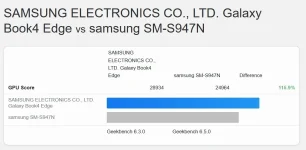
- The Snapdragon X Elite result comes from the Galaxy Book4 Edge.
- This is a notebook-class device losing to a smartphone SoC in OpenCL.
- That alone explains why eyebrows went up fast.
- Once Geekbench 6 switches to Vulkan, the balance changes.
- Snapdragon X Elite posts a score of 28,934.
- That puts it about 15.9 percent ahead.
- The API difference matters, and it shows.
- The Galaxy Book4 Edge was running in Balanced mode.
- High Performance mode likely would have boosted the Vulkan score further.
- This makes the Vulkan gap easier to explain.
- Exynos 2600 Vulkan scores have not been shared yet.
- That leaves a big hole in the comparison.
- A phone-class chip holding its own here would be the real story.
- Samsung says Xclipse 960 delivers up to 50 percent better ray tracing than Xclipse 950.
- Xclipse 950 previously shipped with Exynos 2500.
- These gains sound impressive, but history urges caution.
- Exynos chips have a long record of early hype.
- Overheating and thermal throttling usually follow.
- Vapor chambers did not save earlier flagship phones.
- Raw performance has never been the only problem.
- Samsung is pushing Heat Pass Block technology as the fix.
- HPB reportedly cuts temperatures by up to 30 percent.
- It acts like a built-in heatsink at the silicon level.
- A Samsung executive claims other chipmakers are already interested.
- If HPB works, Exynos finally gets a second chance.
- A cool Exynos 2600 changes the conversation entirely.
- For now, it is promising, suspicious, and familiar all at once.
- The real verdict waits for official launches and sustained workloads.