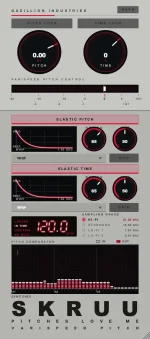
SKRUU gives pitch and time separate elastic controls, and each one can spring back to its starting position after you release it. The useful part happens between release and return. Gazillion gives you control over the trip instead of forcing one fixed snap-back behavior.
A normal pitch control stays where you leave it until you move or automate it, but SKRUU’s elastic pitch and time controls change that behavior. The moved value can travel home on its own, with separate settings for pitch and time. You are shaping a gesture, not just parking a knob.
BITE controls how hard the elastic movement commits. It is separate from RETURN, so the character of the move and the time it takes to recover are not welded together. A quick recovery does not have to mean a timid movement, and a slower recovery does not automatically make the initial change more aggressive.
Pitch and time also get their own elastic sections. You can push pitch away from its starting value while leaving time alone, or move time without forcing pitch to follow. Both can move, but they do not have to behave as a matched pair.
Independent duration control has a long history in digital audio, including research on time-scale modification without linked pitch change. Gazillion does not disclose SKRUU’s internal algorithm, so the research is useful background rather than evidence of how this specific plug-in is coded. The practical point is simpler because SKRUU exposes the separation as something you can play.
Those groups matter more than the novelty of the names. A smooth return can keep a pitch move continuous, while a stepped return deliberately breaks the journey into discrete movements. An overshooting shape goes past the homeward path and comes back, adding an extra change after your hand has already left the control.
The same throw can therefore finish in very different ways without changing its destination. SLOPE handles the route, RETURN handles the duration, and BITE handles how firmly the movement commits. Keeping those jobs separate is what stops the elastic section from behaving like a glorified reset button.
A stepped return also gives rhythmic material a firmer outline because the movement arrives in distinct stages rather than one continuous sweep. An overshooting return behaves differently again, moving past the recovery path before settling, while the RETURN setting still determines how long the trip takes.
DRAG handles a different stage of the motion because Gazillion defines it as the time taken for the new speed to arrive. The minimum setting makes the change immediate, while higher settings lengthen the approach. RETURN governs the trip back after release, while DRAG governs the approach on the way in.
Put those two together and the elastic controls stop being a single bend with a fancy name. A fast DRAG with a longer RETURN gives you an immediate change followed by a drawn-out recovery. A longer DRAG with a quicker RETURN reverses the emphasis, letting the sound ease into the move before getting home more sharply.
A useful setup starts with the direction of travel rather than a preset name. Decide how quickly the sound should reach the moved value with DRAG, then choose the recovery time with RETURN and the route with SLOPE. BITE can stay focused on the force of the movement instead of doing three jobs at once.
Pitch and time have independent elastic systems, so one can creep while the other snaps. One can also stay fixed while the other takes a stepped or overshooting return. Short feature summaries miss the practical payoff because SKRUU gives you separate control over arrival, release, and the path between them.
A normal pitch control stays where you leave it until you move or automate it, but SKRUU’s elastic pitch and time controls change that behavior. The moved value can travel home on its own, with separate settings for pitch and time. You are shaping a gesture, not just parking a knob.
Return and bite decide how the move lands
RETURN sets how long the elastic movement takes to get back to its starting point. Gazillion says the return can run freely or be quantized to the bar. Quantization lets you place release timing against a loop instead of judging it entirely by hand.BITE controls how hard the elastic movement commits. It is separate from RETURN, so the character of the move and the time it takes to recover are not welded together. A quick recovery does not have to mean a timid movement, and a slower recovery does not automatically make the initial change more aggressive.
Pitch and time also get their own elastic sections. You can push pitch away from its starting value while leaving time alone, or move time without forcing pitch to follow. Both can move, but they do not have to behave as a matched pair.
Independent duration control has a long history in digital audio, including research on time-scale modification without linked pitch change. Gazillion does not disclose SKRUU’s internal algorithm, so the research is useful background rather than evidence of how this specific plug-in is coded. The practical point is simpler because SKRUU exposes the separation as something you can play.
Sixteen slopes change the route back
SLOPE determines the shape of the elastic return, and SKRUU provides 16 named choices. They are RAMP, GLIDE, SNAP, WHIP, HANG, CREEP, STAIRS, HALVES, RATCHET, DRUNK, LURCH, BOUNCE, WOBBLE, TREMOR, KICK, and CLIFF. Gazillion groups them into six smooth shapes, five stepped shapes, and five that overshoot before settling back.Those groups matter more than the novelty of the names. A smooth return can keep a pitch move continuous, while a stepped return deliberately breaks the journey into discrete movements. An overshooting shape goes past the homeward path and comes back, adding an extra change after your hand has already left the control.
The same throw can therefore finish in very different ways without changing its destination. SLOPE handles the route, RETURN handles the duration, and BITE handles how firmly the movement commits. Keeping those jobs separate is what stops the elastic section from behaving like a glorified reset button.
A stepped return also gives rhythmic material a firmer outline because the movement arrives in distinct stages rather than one continuous sweep. An overshooting return behaves differently again, moving past the recovery path before settling, while the RETURN setting still determines how long the trip takes.
Grid and drag make the gesture easier to place
GRID belongs to each elastic section, while RETURN can operate freely or in a bar-quantized mode. For material with a strong pulse, that matters because the release does not have to be an isolated manual event. You can set up a movement that snaps, steps, or overshoots while its return is still tied to the musical frame around it.DRAG handles a different stage of the motion because Gazillion defines it as the time taken for the new speed to arrive. The minimum setting makes the change immediate, while higher settings lengthen the approach. RETURN governs the trip back after release, while DRAG governs the approach on the way in.
Put those two together and the elastic controls stop being a single bend with a fancy name. A fast DRAG with a longer RETURN gives you an immediate change followed by a drawn-out recovery. A longer DRAG with a quicker RETURN reverses the emphasis, letting the sound ease into the move before getting home more sharply.
A useful setup starts with the direction of travel rather than a preset name. Decide how quickly the sound should reach the moved value with DRAG, then choose the recovery time with RETURN and the route with SLOPE. BITE can stay focused on the force of the movement instead of doing three jobs at once.
Pitch and time have independent elastic systems, so one can creep while the other snaps. One can also stay fixed while the other takes a stepped or overshooting return. Short feature summaries miss the practical payoff because SKRUU gives you separate control over arrival, release, and the path between them.