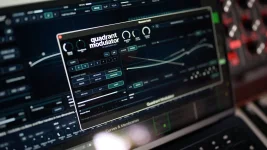
Quadrant Modulator’s One Shot mode plays one complete waveform cycle on each clock or sequencer trigger, then returns its oscillator output to zero. At a slow rate, the shape functions as a small programmable envelope instead of repeating continuously. Push the rate high enough and the same contour becomes a transient event.
The distinction matters because a one-shot modulator has an ending. A normal LFO keeps revisiting every point in its waveform, while a one-shot shape moves through the cycle once and then stops contributing modulation until another trigger arrives. Duration, retrigger timing, and the waveform’s start and end values suddenly matter as much as the shape itself.
The single-cycle shaping inside Quadrant Modulator can remain entirely on one side of zero for ordinary amplitude shaping or cross zero and invert the incoming signal. Slow unipolar shapes can function as custom gain envelopes. Bipolar shapes introduce polarity reversal during the same one-time gesture.
Rate becomes duration in a very literal way. A one-shot cycle running at 2 Hz lasts half a second, while 10 Hz compresses the same normalized shape into one tenth of a second. Nothing about the drawing has changed, yet the ear moves from hearing a slow swell toward hearing a short articulation.
Keeping the waveform positive avoids polarity inversion and makes the behavior easier to treat as amplitude control. Crossing below zero is different because negative multiplier values flip the signal’s polarity while also changing its level. A drawn dip below the center line is therefore not equivalent to pulling a conventional volume envelope lower.
Shape matters more once repetition disappears. A narrow peak can punch out a small slice of audio, while a broad plateau can hold it open before the return to zero. Curves with several bumps can create a miniature rhythmic contour without asking an LFO to loop through the pattern again and again.
Very short events are heard mainly through their transient and spectrum. Research on envelope-shaped percussive clicks models individual clicks with explicit attack and decay envelopes, showing how tiny changes in temporal shape form part of the resulting percussive sound. One-shot modulation can exploit the same territory by turning a drawn cycle into a brief amplitude window over existing audio.
Endpoints become critical here. If the multiplier jumps from zero to a large value at the beginning, or drops abruptly from a large value to zero at the end, the processed waveform can acquire a discontinuity. Abrupt discontinuities contain broad high-frequency energy, which is why badly cut audio edits produce clicks.
A smooth start and finish can produce a controlled transient. Sharp nodes can do the opposite on purpose, carving hard cuts or click patterns into sustained material. The waveform editor therefore becomes a compact transient-shaping control.
Rhythm becomes exact when the trigger source is exact. Put a half-second contour behind quarter-note triggers that arrive faster than every half second, and retrigger behavior determines whether the listener hears complete shapes or repeated restarts. Shorter cycles leave more room between events, while longer cycles make trigger spacing part of the articulation itself.
Retriggering can also expose discontinuities. If a new trigger forces the modulator back to its starting value while the current cycle sits somewhere else, the multiplier value may jump instantly. Smooth shapes are not automatically click-free when the reset itself is abrupt.
Practical programming starts with the destination rather than the waveform picture. For a volume gesture, keep the cycle positive, begin and end near zero, then set the rate from the duration you actually want. For clicks and cuts, shorten the cycle and use sharper transitions deliberately, because at that scale the edge of the contour is no longer a minor detail.
The distinction matters because a one-shot modulator has an ending. A normal LFO keeps revisiting every point in its waveform, while a one-shot shape moves through the cycle once and then stops contributing modulation until another trigger arrives. Duration, retrigger timing, and the waveform’s start and end values suddenly matter as much as the shape itself.
The single-cycle shaping inside Quadrant Modulator can remain entirely on one side of zero for ordinary amplitude shaping or cross zero and invert the incoming signal. Slow unipolar shapes can function as custom gain envelopes. Bipolar shapes introduce polarity reversal during the same one-time gesture.
A single cycle becomes a custom envelope
An ADSR envelope is built from named stages, but a one-shot waveform does not need attack, decay, sustain, and release controls to perform a similar job. If its amplitude begins near zero, rises, changes shape, and returns to zero, multiplying audio by that contour creates a finite gain event. The drawing itself decides where the attack bends, how long the body lasts, and how sharply the sound disappears.Rate becomes duration in a very literal way. A one-shot cycle running at 2 Hz lasts half a second, while 10 Hz compresses the same normalized shape into one tenth of a second. Nothing about the drawing has changed, yet the ear moves from hearing a slow swell toward hearing a short articulation.
Keeping the waveform positive avoids polarity inversion and makes the behavior easier to treat as amplitude control. Crossing below zero is different because negative multiplier values flip the signal’s polarity while also changing its level. A drawn dip below the center line is therefore not equivalent to pulling a conventional volume envelope lower.
Shape matters more once repetition disappears. A narrow peak can punch out a small slice of audio, while a broad plateau can hold it open before the return to zero. Curves with several bumps can create a miniature rhythmic contour without asking an LFO to loop through the pattern again and again.
Fast one-shots become transient shapers
Shortening the cycle eventually changes how you perceive the result. Slow amplitude movement produces a swell, duck, pulse, or brief tremolo gesture. Compress the same event into a few milliseconds and there may be too little time for the ear to follow its contour as movement.Very short events are heard mainly through their transient and spectrum. Research on envelope-shaped percussive clicks models individual clicks with explicit attack and decay envelopes, showing how tiny changes in temporal shape form part of the resulting percussive sound. One-shot modulation can exploit the same territory by turning a drawn cycle into a brief amplitude window over existing audio.
Endpoints become critical here. If the multiplier jumps from zero to a large value at the beginning, or drops abruptly from a large value to zero at the end, the processed waveform can acquire a discontinuity. Abrupt discontinuities contain broad high-frequency energy, which is why badly cut audio edits produce clicks.
A smooth start and finish can produce a controlled transient. Sharp nodes can do the opposite on purpose, carving hard cuts or click patterns into sustained material. The waveform editor therefore becomes a compact transient-shaping control.
Retrigger timing decides whether the contour stays intact
A one-shot is only predictable when you know what a new trigger does to the current cycle. Quadrant Modulator restarts One Shot from clock impulses, including cases where only one sequencer slot is active. A new trigger can therefore establish a fresh cycle rather than waiting for the free-running phase to come around.Rhythm becomes exact when the trigger source is exact. Put a half-second contour behind quarter-note triggers that arrive faster than every half second, and retrigger behavior determines whether the listener hears complete shapes or repeated restarts. Shorter cycles leave more room between events, while longer cycles make trigger spacing part of the articulation itself.
Retriggering can also expose discontinuities. If a new trigger forces the modulator back to its starting value while the current cycle sits somewhere else, the multiplier value may jump instantly. Smooth shapes are not automatically click-free when the reset itself is abrupt.
Practical programming starts with the destination rather than the waveform picture. For a volume gesture, keep the cycle positive, begin and end near zero, then set the rate from the duration you actually want. For clicks and cuts, shorten the cycle and use sharper transitions deliberately, because at that scale the edge of the contour is no longer a minor detail.