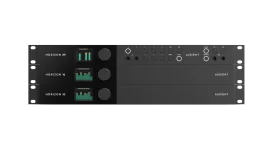
Audient gives the Horizon 16 sixteen line inputs and sixteen line outputs across four Tascam-format DB25 connectors. Horizon 32 doubles the primary analog path to 32 inputs and 32 outputs across eight connectors, while both models add separate stereo line inputs and dedicated monitor outputs.
The useful part is not simply channel count. A Horizon interface for hybrid studios can leave compressors, equalizers, summing hardware, and console paths physically wired while Horizon Control handles which source reaches each output.
Once a room reaches that point, DB25 stops being cable economy and becomes workflow design. The difference between a tidy hybrid setup and a frustrating one is usually whether routing, calibration, monitoring, and clocking were planned separately.
A common hybrid path sends a DAW output through Horizon to an analog compressor or EQ, then returns the processed signal through a Horizon line input. A patchbay can sit between the interface and rack, so the normal signal path stays connected until you deliberately change it.
Permanent wiring matters most when several processors are used every day. You can reserve output and input pairs for stereo compressors, equalizers, reverbs, or a summing mixer instead of rebuilding the back of the rack every session. Horizon Control then acts as the software layer above those physical connections.
The routing matrix works per Horizon unit, with sources across the top and physical destinations down the side. One limitation is easy to miss in a large system. A source cannot be routed directly through the matrix of one Horizon into a physical output belonging to another Horizon unit.
Balanced wiring also deserves more attention than the connector count suggests. Poor shielding and grounding practices can turn a functional patching scheme into hum or interference, particularly when many mains-powered devices are connected. The engineering behind balanced audio interconnection behavior is part of building a quiet rack, not decorative theory after the cabling is finished.
Six decibels is a meaningful difference in a hybrid chain. Equipment designed around higher professional line levels may benefit from +24 dBu because more analog voltage is available before the converter reaches digital full scale. Gear that reaches its preferred operating region earlier may fit +18 dBu more naturally.
Audient specifies +24 dBu as 0 dBFS for the Horizon 16 converter path at its maximum setting. Switching operating level is not the same thing as adding six decibels with a DAW fader. You are changing the relationship between analog voltage and the converter ceiling.
Bank-level control is useful when a rack is mixed rather than uniform. Eight outputs feeding modern mastering hardware can run at +24 dBu while another bank feeding lower-headroom equipment uses +18 dBu. The sensible choice gives the connected hardware usable headroom without forcing every DAW send to an awkward level.
A 16-channel outboard loop can remain patched while the stereo result comes back on inputs 17 and 18. On Horizon 32, the same idea leaves all 32 primary inputs available. Dedicated monitor outputs also keep speaker control separate from the main line-output banks.
Word clock becomes important when digital devices enter the system or several Horizon units are chained. Multiple Horizon units can share Thunderbolt for host audio and control, but Audient requires separate BNC word clock between them. The primary unit supplies timing to the secondary devices.
Termination belongs at the end of the BNC chain. Horizon provides switchable 75-ohm termination, which should be enabled on the final receiving device and left off where the clock connection continues onward. Getting this wrong can produce clicks and unstable locking that people sometimes blame on the DAW.
The cleanest hybrid layout keeps those layers distinct. DB25 handles analog traffic, Horizon Control handles source-to-output routing, the reference setting matches voltage ranges, and BNC handles timing where digital synchronization is required. Once those jobs are separated, permanent patching becomes easier to troubleshoot when one processor, route, or clock source behaves badly.
The useful part is not simply channel count. A Horizon interface for hybrid studios can leave compressors, equalizers, summing hardware, and console paths physically wired while Horizon Control handles which source reaches each output.
Once a room reaches that point, DB25 stops being cable economy and becomes workflow design. The difference between a tidy hybrid setup and a frustrating one is usually whether routing, calibration, monitoring, and clocking were planned separately.
Permanent DB25 routing changes how the room works
Each DB25 on Horizon carries eight balanced analog channels using the Tascam and AES59 pinout. Horizon 16 uses two connectors for its 16 inputs and two for its 16 outputs, while Horizon 32 scales the same arrangement to four input and four output connectors.A common hybrid path sends a DAW output through Horizon to an analog compressor or EQ, then returns the processed signal through a Horizon line input. A patchbay can sit between the interface and rack, so the normal signal path stays connected until you deliberately change it.
Permanent wiring matters most when several processors are used every day. You can reserve output and input pairs for stereo compressors, equalizers, reverbs, or a summing mixer instead of rebuilding the back of the rack every session. Horizon Control then acts as the software layer above those physical connections.
The routing matrix works per Horizon unit, with sources across the top and physical destinations down the side. One limitation is easy to miss in a large system. A source cannot be routed directly through the matrix of one Horizon into a physical output belonging to another Horizon unit.
Balanced wiring also deserves more attention than the connector count suggests. Poor shielding and grounding practices can turn a functional patching scheme into hum or interference, particularly when many mains-powered devices are connected. The engineering behind balanced audio interconnection behavior is part of building a quiet rack, not decorative theory after the cabling is finished.
Reference levels decide where analog headroom lands
Horizon 16 lets you set analog reference levels by connector bank rather than forcing one value across the whole interface. Inputs 1 through 8, 9 through 16, and the additional stereo pair can each use +18 dBu or +24 dBu operation. The output banks offer the same choices.Six decibels is a meaningful difference in a hybrid chain. Equipment designed around higher professional line levels may benefit from +24 dBu because more analog voltage is available before the converter reaches digital full scale. Gear that reaches its preferred operating region earlier may fit +18 dBu more naturally.
Audient specifies +24 dBu as 0 dBFS for the Horizon 16 converter path at its maximum setting. Switching operating level is not the same thing as adding six decibels with a DAW fader. You are changing the relationship between analog voltage and the converter ceiling.
Bank-level control is useful when a rack is mixed rather than uniform. Eight outputs feeding modern mastering hardware can run at +24 dBu while another bank feeding lower-headroom equipment uses +18 dBu. The sensible choice gives the connected hardware usable headroom without forcing every DAW send to an awkward level.
The mix bus and word clock solve different problems
Both Horizon 16 and Horizon 32 provide a separate stereo input pair beyond their primary DB25 channels. Audient positions this path for capturing the final output of a console or summing chain, so your main analog returns do not have to be sacrificed just to print the mix.A 16-channel outboard loop can remain patched while the stereo result comes back on inputs 17 and 18. On Horizon 32, the same idea leaves all 32 primary inputs available. Dedicated monitor outputs also keep speaker control separate from the main line-output banks.
Word clock becomes important when digital devices enter the system or several Horizon units are chained. Multiple Horizon units can share Thunderbolt for host audio and control, but Audient requires separate BNC word clock between them. The primary unit supplies timing to the secondary devices.
Termination belongs at the end of the BNC chain. Horizon provides switchable 75-ohm termination, which should be enabled on the final receiving device and left off where the clock connection continues onward. Getting this wrong can produce clicks and unstable locking that people sometimes blame on the DAW.
The cleanest hybrid layout keeps those layers distinct. DB25 handles analog traffic, Horizon Control handles source-to-output routing, the reference setting matches voltage ranges, and BNC handles timing where digital synchronization is required. Once those jobs are separated, permanent patching becomes easier to troubleshoot when one processor, route, or clock source behaves badly.