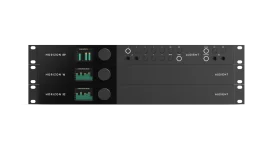
Audient prices the Horizon 8P and Horizon 16 at the same $2,799 in the US, despite building them for very different jobs. The 8P spends much of its hardware on recording sources directly, while the 16 spends its budget on getting more external analog equipment in and out of the DAW.
Price alone tells you little. The useful comparison starts with what is already in your rack and what you would otherwise have to buy around the Audient Horizon interface range.
Both share 32-bit conversion, Thunderbolt 3, the same macOS driver, ADAT expansion, and a 1U fanless chassis. The split happens at the analog front end.
Horizon 16 has no microphone preamps. Its main job is sixteen channels of line input and sixteen channels of line output over four DB25 connectors, plus dedicated stereo monitor outputs and a separate stereo mix-bus input. A microphone cannot simply be plugged into that line-level architecture and treated like it is connected to the 8P.
The missing preamps change the real purchase. A Horizon 16 used for an eight-mic drum session needs eight channels of external microphone amplification before those signals reach its converters. If you already own the preamps, good. If you do not, the equal $2,799 sticker prices stop describing equal systems.
The reverse applies to outboard-heavy mixing. Horizon 8P provides eight DB25 line inputs and outputs for hardware integration, while Horizon 16 provides sixteen primary line inputs and sixteen outputs. Filling a rack with stereo compressors and EQs consumes pairs quickly, so eight extra send-and-return channels can matter more than built-in preamps you rarely use.
A singer and guitarist can both monitor from the rack while two instruments enter the front panel and microphones occupy the preamps. A drum session can use all eight console preamps without an external front end. You can still connect eight channels of line-level outboard through DB25 when mixing.
Preamp bypass also matters if your studio grows later. The 8P can switch a channel from its microphone input to the DB25 line input and feed that line signal directly toward conversion, so choosing the tracking model does not lock every analog input behind the built-in preamp.
Gain architecture is part of the distinction. Analog gain before conversion determines the level presented to an ADC before later digital trimming can happen. Horizon 8P gives you that microphone gain inside the chassis. Horizon 16 expects another device to do it first.
Dual headphone feeds and flexible talkback sound mundane until several people are recording at once. Then they save patching, extra hardware, and the small interruptions that make a simple session feel clumsy.
The dedicated stereo mix-bus input is another difference with practical weight. All sixteen primary inputs can stay assigned to outboard returns while a console or summing mixer feeds its final stereo output into the separate capture path. You do not have to sacrifice a normal return pair every time you print a mix.
Selectable +18 dBu and +24 dBu reference levels also help when the rack contains equipment designed around different operating levels. Proper level matching keeps useful headroom through the analog chain instead of solving every mismatch with DAW faders after conversion.
The deciding number is not 24 inputs versus 34 inputs. Count how many microphones you record simultaneously, how many external preamp channels you own, and how many analog send-and-return paths need to stay patched. A studio tracking bands from scratch can use nearly every specialized feature on the 8P, while a room with sixteen channels of established analog gear can immediately use the extra line conversion on the 16.
Horizon 8P leaves eight DB25 line channels available when its microphone side is doing the recording work. Horizon 16 gives you twice that primary line capacity but expects the rack to supply microphone gain, instrument front ends, and any additional performer headphone distribution your sessions require.
Price alone tells you little. The useful comparison starts with what is already in your rack and what you would otherwise have to buy around the Audient Horizon interface range.
Both share 32-bit conversion, Thunderbolt 3, the same macOS driver, ADAT expansion, and a 1U fanless chassis. The split happens at the analog front end.
The shared price hides different system costs
Horizon 8P gives you eight Audient Console mic preamps with 75 dB of gain, per-channel phantom power, a sweepable high-pass filter, pad, digital gain recall, and ORBIT variable impedance. Channels one and two also provide JFET instrument inputs. For a room that regularly records microphones, those features replace separate boxes, cabling, and extra gain-control steps.Horizon 16 has no microphone preamps. Its main job is sixteen channels of line input and sixteen channels of line output over four DB25 connectors, plus dedicated stereo monitor outputs and a separate stereo mix-bus input. A microphone cannot simply be plugged into that line-level architecture and treated like it is connected to the 8P.
The missing preamps change the real purchase. A Horizon 16 used for an eight-mic drum session needs eight channels of external microphone amplification before those signals reach its converters. If you already own the preamps, good. If you do not, the equal $2,799 sticker prices stop describing equal systems.
The reverse applies to outboard-heavy mixing. Horizon 8P provides eight DB25 line inputs and outputs for hardware integration, while Horizon 16 provides sixteen primary line inputs and sixteen outputs. Filling a rack with stereo compressors and EQs consumes pairs quickly, so eight extra send-and-return channels can matter more than built-in preamps you rarely use.
Horizon 8P spends more hardware on the tracking room
The 8P is unusually self-contained for sessions with performers. Two headphone outputs, two speaker pairs, talkback, four cue mixes, two front-panel instrument inputs, and eight recalled mic gains reduce the supporting hardware needed around the interface.A singer and guitarist can both monitor from the rack while two instruments enter the front panel and microphones occupy the preamps. A drum session can use all eight console preamps without an external front end. You can still connect eight channels of line-level outboard through DB25 when mixing.
Preamp bypass also matters if your studio grows later. The 8P can switch a channel from its microphone input to the DB25 line input and feed that line signal directly toward conversion, so choosing the tracking model does not lock every analog input behind the built-in preamp.
Gain architecture is part of the distinction. Analog gain before conversion determines the level presented to an ADC before later digital trimming can happen. Horizon 8P gives you that microphone gain inside the chassis. Horizon 16 expects another device to do it first.
Dual headphone feeds and flexible talkback sound mundane until several people are recording at once. Then they save patching, extra hardware, and the small interruptions that make a simple session feel clumsy.
Horizon 16 earns its keep when the rack already exists
Horizon 16 starts making more sense when your studio already owns its preferred preamps, channel strips, compressors, EQs, or summing hardware. Its sixteen-by-sixteen DB25 layout gives those devices a wider permanent path to the DAW without paying for eight onboard microphone preamps that duplicate what you already have.The dedicated stereo mix-bus input is another difference with practical weight. All sixteen primary inputs can stay assigned to outboard returns while a console or summing mixer feeds its final stereo output into the separate capture path. You do not have to sacrifice a normal return pair every time you print a mix.
Selectable +18 dBu and +24 dBu reference levels also help when the rack contains equipment designed around different operating levels. Proper level matching keeps useful headroom through the analog chain instead of solving every mismatch with DAW faders after conversion.
The deciding number is not 24 inputs versus 34 inputs. Count how many microphones you record simultaneously, how many external preamp channels you own, and how many analog send-and-return paths need to stay patched. A studio tracking bands from scratch can use nearly every specialized feature on the 8P, while a room with sixteen channels of established analog gear can immediately use the extra line conversion on the 16.
Horizon 8P leaves eight DB25 line channels available when its microphone side is doing the recording work. Horizon 16 gives you twice that primary line capacity but expects the rack to supply microphone gain, instrument front ends, and any additional performer headphone distribution your sessions require.