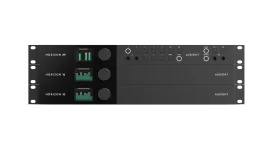
Audient’s Horizon 8P gives each of its eight mic preamps three ORBIT impedance settings of 2.8 kΩ, 1.2 kΩ, and 220 Ω. Those values change the electrical load presented to the microphone before the signal reaches the converter.
In the Horizon 8P tracking interface, ORBIT is not an EQ preset or a digital coloration mode. Audient describes it as relay-based variable impedance, so the microphone sees a different analog load when you switch between High, Mid, and Low.
The practical effect depends heavily on the microphone. Dynamic and passive ribbon designs can react more noticeably because their output impedance is often frequency-dependent, while an actively buffered condenser may change much less.
A 1955 AES Journal paper on microphone loading behavior gave a useful engineering rule. It recommended a preamp input impedance at least five times the microphone’s nominal impedance when the goal is to avoid unwanted changes in frequency response, unless the preamp was designed around a particular microphone.
Apply that rule to a 150 Ω microphone and the minimum lands at 750 Ω. ORBIT’s 1.2 kΩ and 2.8 kΩ settings sit above it, while the 220 Ω setting deliberately moves into much heavier loading.
A microphone rated at 200 Ω pushes the five-times figure to 1 kΩ. Mid still clears it, High clears it comfortably, and Low again becomes the intentionally aggressive option rather than the neutral one.
Real microphones are not fixed resistors, so those figures are not universal predictions. Their impedance can move with frequency because transformers, coils, capacitive elements, and active circuitry all behave differently across the spectrum.
Frequency-dependent loading is where the tonal change comes from. A lower load can pull down overall level while changing resonances or the balance between parts of the spectrum, especially on passive dynamic and ribbon microphones. A higher load usually interferes less with the microphone’s own electrical behavior.
Audient’s own older ASP880 used the same selectable mic-load values of 220 Ω, 1.2 kΩ, and 2.8 kΩ. ORBIT therefore gives Horizon 8P users a familiar Audient loading range inside the newer interface rather than introducing an unexplained set of arbitrary voicings.
A passive ribbon deserves particular care because its output transformer can present a load that changes substantially with frequency. Heavy loading may reduce level and alter its response enough to be useful on one source and undesirable on another. Active ribbon microphones can behave differently because their electronics isolate the ribbon element from the preamp load.
The same caution applies to common moving-coil dynamics. Audient has previously used a 310 Ω SM57 to explain variable impedance, and a five-times loading guideline would put the neutral target above 1.55 kΩ. On ORBIT, only the 2.8 kΩ setting clears that threshold, while 1.2 kΩ and 220 Ω create progressively heavier interaction.
Gain matching matters when you compare settings. Switching to Low can reduce microphone output, and a quieter signal can sound subjectively different before any genuine tonal shift is considered. Reset the preamp gain so playback level is close before deciding whether ORBIT changed the tone in a useful way.
Phantom power is a separate control from impedance. Horizon 8P provides independent 48 V power per channel, while ORBIT changes the input load, so selecting Low does not mean the interface is supplying less phantom voltage or changing condenser power.
The most revealing use is at the start of a recording chain with no corrective processing hiding the result. A bright dynamic on an aggressive guitar cabinet may benefit from a heavier load, while a passive ribbon that already sounds dark may keep more openness at 2.8 kΩ. The microphone, source, distance, and preamp gain still matter more than the label on the switch.
In the Horizon 8P tracking interface, ORBIT is not an EQ preset or a digital coloration mode. Audient describes it as relay-based variable impedance, so the microphone sees a different analog load when you switch between High, Mid, and Low.
The practical effect depends heavily on the microphone. Dynamic and passive ribbon designs can react more noticeably because their output impedance is often frequency-dependent, while an actively buffered condenser may change much less.
Microphone input impedance changes before conversion
A microphone and preamp form an electrical source-and-load relationship. Modern mic inputs are usually designed with considerably higher impedance than the microphone feeding them, which reduces loading and preserves more of the microphone’s available voltage.A 1955 AES Journal paper on microphone loading behavior gave a useful engineering rule. It recommended a preamp input impedance at least five times the microphone’s nominal impedance when the goal is to avoid unwanted changes in frequency response, unless the preamp was designed around a particular microphone.
Apply that rule to a 150 Ω microphone and the minimum lands at 750 Ω. ORBIT’s 1.2 kΩ and 2.8 kΩ settings sit above it, while the 220 Ω setting deliberately moves into much heavier loading.
A microphone rated at 200 Ω pushes the five-times figure to 1 kΩ. Mid still clears it, High clears it comfortably, and Low again becomes the intentionally aggressive option rather than the neutral one.
Higher impedance usually keeps more level intact
The voltage relationship is easy to underestimate because impedance switching can alter level before you touch the gain control. Using a simple 150 Ω resistive source model, a 2.8 kΩ load loses only about 0.45 dB compared with the unloaded source voltage. The same model loses roughly 1 dB into 1.2 kΩ and about 4.5 dB into 220 Ω.Real microphones are not fixed resistors, so those figures are not universal predictions. Their impedance can move with frequency because transformers, coils, capacitive elements, and active circuitry all behave differently across the spectrum.
Frequency-dependent loading is where the tonal change comes from. A lower load can pull down overall level while changing resonances or the balance between parts of the spectrum, especially on passive dynamic and ribbon microphones. A higher load usually interferes less with the microphone’s own electrical behavior.
Audient’s own older ASP880 used the same selectable mic-load values of 220 Ω, 1.2 kΩ, and 2.8 kΩ. ORBIT therefore gives Horizon 8P users a familiar Audient loading range inside the newer interface rather than introducing an unexplained set of arbitrary voicings.
Low impedance is a deliberate recording choice
Low should not be treated as the better setting for vintage microphones, nor should High automatically be treated as the correct setting for modern ones. The microphone’s output circuit decides how dramatic the change becomes, and two models with similar nominal impedance can still react differently.A passive ribbon deserves particular care because its output transformer can present a load that changes substantially with frequency. Heavy loading may reduce level and alter its response enough to be useful on one source and undesirable on another. Active ribbon microphones can behave differently because their electronics isolate the ribbon element from the preamp load.
The same caution applies to common moving-coil dynamics. Audient has previously used a 310 Ω SM57 to explain variable impedance, and a five-times loading guideline would put the neutral target above 1.55 kΩ. On ORBIT, only the 2.8 kΩ setting clears that threshold, while 1.2 kΩ and 220 Ω create progressively heavier interaction.
Gain matching matters when you compare settings. Switching to Low can reduce microphone output, and a quieter signal can sound subjectively different before any genuine tonal shift is considered. Reset the preamp gain so playback level is close before deciding whether ORBIT changed the tone in a useful way.
Phantom power is a separate control from impedance. Horizon 8P provides independent 48 V power per channel, while ORBIT changes the input load, so selecting Low does not mean the interface is supplying less phantom voltage or changing condenser power.
The most revealing use is at the start of a recording chain with no corrective processing hiding the result. A bright dynamic on an aggressive guitar cabinet may benefit from a heavier load, while a passive ribbon that already sounds dark may keep more openness at 2.8 kΩ. The microphone, source, distance, and preamp gain still matter more than the label on the switch.