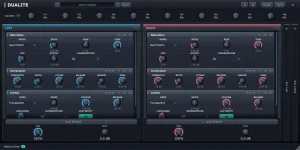
Dualite processes stereo signals through two independent effect chains for 15 euros. This 23DSP plugin switches between left/right and mid/side modes letting users apply different processing to each channel or frequency domain separately.
Each chain holds eight effects from a 24-module library including granulators, convolution reverbs, and frequency shifters. Parallel lanes sit behind main paths with dedicated send controls enabling compression blends that leave dry signals untouched during mixing.
Four modulation slots assign LFOs, envelope followers, or ADSRs to any parameter across both chains independently. Envelope readers tap anywhere in the signal path while opposite polarity settings push stereo sides in contrasting directions for creative movement.
Ninety presets span tone shaping, lo-fi, and sound design categories with searchable instrument tags. A/B snapshots compare complete states while 64 undo levels cover chain edits and modulation assignments without losing work during experimentation.
Automation binds to slot positions so reordering effects preserves existing host bindings seamlessly. Per-effect oversampling handles nonlinear processing while latency reporting ensures proper delay compensation across Windows, macOS, and Linux platforms running VST3, AU, or LV2 formats.
Each chain holds eight effects from a 24-module library including granulators, convolution reverbs, and frequency shifters. Parallel lanes sit behind main paths with dedicated send controls enabling compression blends that leave dry signals untouched during mixing.
Four modulation slots assign LFOs, envelope followers, or ADSRs to any parameter across both chains independently. Envelope readers tap anywhere in the signal path while opposite polarity settings push stereo sides in contrasting directions for creative movement.
Ninety presets span tone shaping, lo-fi, and sound design categories with searchable instrument tags. A/B snapshots compare complete states while 64 undo levels cover chain edits and modulation assignments without losing work during experimentation.
Automation binds to slot positions so reordering effects preserves existing host bindings seamlessly. Per-effect oversampling handles nonlinear processing while latency reporting ensures proper delay compensation across Windows, macOS, and Linux platforms running VST3, AU, or LV2 formats.