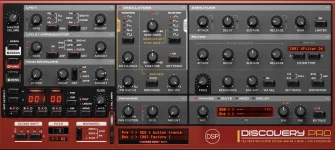
Discovery Pro 9.3 adds a Retro oscillator engine modeled on the Nord Lead 2X hardware synth and four of its core waveforms. Saw, triangle, sine, and pulse are the direct references, and discoDSP describes the result as deliberately coarser and more digital. The point is character, not another cleanliness setting.
Retro sits beside High Quality and Classic rather than replacing either one. High Quality is discoDSP’s modern oscillator core, while Classic preserves the older 90s-style mipmap wavetable behavior used by earlier banks. Picking Retro gives you a third rendering choice with a different target entirely.
The Nord Lead 2X itself is digital hardware built around virtual analog synthesis. Its first oscillator offers sine, triangle, sawtooth and pulse, while the second uses triangle, sawtooth, and pulse alongside noise. Discovery Pro’s Retro mode focuses on the four pitched shapes named in discoDSP’s 9.3 notes, so the familiar red-synth connection is coming from oscillator behavior rather than a vague vintage label.
High Quality takes the opposite route in practical terms. discoDSP describes that engine as cleaner in the top end, stronger in the bass and free from aliasing in the high register. Retro does not try to win the same contest, which is useful when an immaculate oscillator leaves a patch feeling a little too polished.
Digital saw and pulse waves are awkward things to generate cleanly because their sharp discontinuities create harmonics far beyond the available sample rate. Work on band-limited virtual analog oscillator design deals directly with reducing those folded-back components. None of this means Retro simply adds aliasing for flavor, and discoDSP does not make that claim.
Filters are a separate story inside Discovery Pro. The synth already has Nord-flavored filter models alongside Moog Ladder and Oberheim SEM options, while Retro is presented as an oscillator engine choice. You can pair the rougher oscillator rendering with whatever filter and modulation decisions suit the patch instead of treating it as a locked hardware preset.
The Discovery Pro 9.3 Retro oscillator engine therefore makes the most sense as a tone-source decision. Start with a simple saw or pulse patch and compare the three engines at matched settings. Dense effects can bury the difference before you have heard what the oscillator itself is contributing.
Saw is the obvious stress test because it carries a dense harmonic series. Pulse is equally useful once pulse width starts moving, while sine gives you a much barer reference and triangle sits between those extremes. Switching engines on uncomplicated material tells you more than throwing Retro onto a finished stack and hoping for instant nostalgia.
Super 7 makes the distinction especially clear. Discovery Pro already uses it as a seven-saw oscillator for broad stacked sounds, yet the 2X hardware specification lists no comparable supersaw waveform. Sending Super 7 through Retro lets the engine’s coarser digital behavior reach a waveform that belongs to Discovery Pro’s wider oscillator set.
Parabolic follows the same logic without pretending to be something from the red hardware panel. It gains the new rendering path because discoDSP chose to run it through the same engine. For sound design, Retro can color familiar Discovery Pro material even when you are not building an explicitly Nord-styled patch.
Retro sits beside High Quality and Classic rather than replacing either one. High Quality is discoDSP’s modern oscillator core, while Classic preserves the older 90s-style mipmap wavetable behavior used by earlier banks. Picking Retro gives you a third rendering choice with a different target entirely.
Retro is not just Classic with a new label
Classic exists partly for continuity. Older sounds can keep the oscillator behavior they were built around instead of being forced through the newer engine, which matters when a small change in harmonic balance can alter a bright lead or resonant patch. Retro is aimed somewhere else because its reference is specific hardware rather than Discovery Pro’s own previous oscillator generation.The Nord Lead 2X itself is digital hardware built around virtual analog synthesis. Its first oscillator offers sine, triangle, sawtooth and pulse, while the second uses triangle, sawtooth, and pulse alongside noise. Discovery Pro’s Retro mode focuses on the four pitched shapes named in discoDSP’s 9.3 notes, so the familiar red-synth connection is coming from oscillator behavior rather than a vague vintage label.
High Quality takes the opposite route in practical terms. discoDSP describes that engine as cleaner in the top end, stronger in the bass and free from aliasing in the high register. Retro does not try to win the same contest, which is useful when an immaculate oscillator leaves a patch feeling a little too polished.
Digital saw and pulse waves are awkward things to generate cleanly because their sharp discontinuities create harmonics far beyond the available sample rate. Work on band-limited virtual analog oscillator design deals directly with reducing those folded-back components. None of this means Retro simply adds aliasing for flavor, and discoDSP does not make that claim.
The Nord Lead 2X reference has clear boundaries
Calling Retro Nord Lead 2X modeled tells you more than calling it vintage, but it still needs reading carefully. discoDSP names the hardware and the saw, triangle, sine and pulse shapes specifically. It does not describe Retro as a component-level recreation of the entire Nord signal path.Filters are a separate story inside Discovery Pro. The synth already has Nord-flavored filter models alongside Moog Ladder and Oberheim SEM options, while Retro is presented as an oscillator engine choice. You can pair the rougher oscillator rendering with whatever filter and modulation decisions suit the patch instead of treating it as a locked hardware preset.
The Discovery Pro 9.3 Retro oscillator engine therefore makes the most sense as a tone-source decision. Start with a simple saw or pulse patch and compare the three engines at matched settings. Dense effects can bury the difference before you have heard what the oscillator itself is contributing.
Saw is the obvious stress test because it carries a dense harmonic series. Pulse is equally useful once pulse width starts moving, while sine gives you a much barer reference and triangle sits between those extremes. Switching engines on uncomplicated material tells you more than throwing Retro onto a finished stack and hoping for instant nostalgia.
Parabolic and Super 7 reveal what Retro really is
The stranger detail in 9.3 is that Parabolic and Super 7 are rendered by the Retro engine too. Neither appears in the Nord Lead 2X oscillator specification, so discoDSP is clearly using the new engine beyond the four hardware-referenced shapes. Retro is therefore more useful to think of as a rendering architecture with a Nord 2X target at its center, not a tiny museum of copied waveforms.Super 7 makes the distinction especially clear. Discovery Pro already uses it as a seven-saw oscillator for broad stacked sounds, yet the 2X hardware specification lists no comparable supersaw waveform. Sending Super 7 through Retro lets the engine’s coarser digital behavior reach a waveform that belongs to Discovery Pro’s wider oscillator set.
Parabolic follows the same logic without pretending to be something from the red hardware panel. It gains the new rendering path because discoDSP chose to run it through the same engine. For sound design, Retro can color familiar Discovery Pro material even when you are not building an explicitly Nord-styled patch.