NVIDIA lists the desktop RTX Spark N1X at 140W TDP, while its full 6,144-core laptop version runs within a 45 to 80W range. Those figures describe two power classes for closely related silicon, not two measurements of how much a finished PC pulls from the wall.
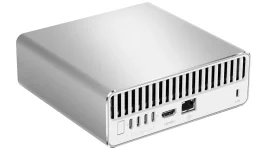
MSI’s EdgeMesa N AI+ desktop hardware uses the 20-core Grace CPU and 6,144-core Blackwell GPU configuration that NVIDIA lists for desktop RTX Spark N1X. MSI also specifies a fan cooler with a vapor chamber, which makes sense for a small desktop designed around the higher power envelope.
The number worth keeping straight is 140W. It tells you something useful about the Superchip’s thermal class, but it does not give you EdgeMesa idle draw, gaming draw, AI inference draw, peak socket power, or the size of the power adapter MSI will ship.
DGX Spark makes the distinction easy to see because NVIDIA separately specifies a 240W external power supply. The same documentation leaves 100W of that supply capacity available for the SSD, networking, USB-C, and other system components, so treating 140W as a measured whole-box figure would mix two different numbers.
EdgeMesa does not currently come with an equivalent public breakdown from MSI. The company lists its processor, GPU, memory, NVMe storage, networking, ports and cooling hardware, but its public specification page does not state a complete system power figure or publish measured wall consumption.
TDP also is not a promise that the Superchip sits at 140W all day. Power changes with workload, utilization, and power management, while a thermal rating mainly tells the system designer what class of sustained heat the cooling solution needs to handle.
Core counts therefore tell only part of the performance story. A processor allowed to operate inside a much larger thermal envelope has more room for sustained clocks and simultaneous CPU-GPU load, but actual EdgeMesa performance still needs measurements rather than a wattage-based guess.
MSI’s vapor-chamber cooler matters for the same reason. A small desktop can avoid the battery limits and thin cooling assemblies that shape laptop behavior, yet chassis airflow, fan tuning, ambient temperature, and firmware power limits can still decide how long the chip holds its faster operating state.
The same caution applies to AI power efficiency. Measured LLM inference energy data across 21 GPU configurations and 155 model architectures shows how workload and operating conditions move energy demand, so a single TDP number cannot tell you the energy cost of generating a token or running a long context.
The 6,144 CUDA cores create another easy trap. A laptop N1X and desktop N1X can share the same CUDA-core count while sitting in very different power envelopes, so benchmark results from one form factor should not automatically be pasted onto the other.
Whole-system consumption adds more pieces. Storage, Wi-Fi, 10Gb Ethernet, USB devices, display outputs, cooling hardware and power-conversion losses all sit outside a simple CPU-plus-GPU headline, while light workloads may leave much of the Superchip below its maximum thermal budget.
A useful EdgeMesa power test therefore needs AC wall measurements at idle and under repeatable CPU, GPU and local AI loads, alongside temperatures and fan behavior. Until retail hardware produces those numbers, 140W is best treated as the desktop RTX Spark N1X Superchip rating, not a confirmed claim about what an EdgeMesa N AI+ will draw from your outlet.
MSI’s EdgeMesa N AI+ desktop hardware uses the 20-core Grace CPU and 6,144-core Blackwell GPU configuration that NVIDIA lists for desktop RTX Spark N1X. MSI also specifies a fan cooler with a vapor chamber, which makes sense for a small desktop designed around the higher power envelope.
The number worth keeping straight is 140W. It tells you something useful about the Superchip’s thermal class, but it does not give you EdgeMesa idle draw, gaming draw, AI inference draw, peak socket power, or the size of the power adapter MSI will ship.
The 140W rating belongs to the Superchip
NVIDIA labels 140W as the desktop RTX Spark N1X TDP. Its DGX Spark documentation is even more explicit for the closely related GB10 platform, describing 140W as the SoC thermal design power covering the CPU and GPU rather than the complete machine.DGX Spark makes the distinction easy to see because NVIDIA separately specifies a 240W external power supply. The same documentation leaves 100W of that supply capacity available for the SSD, networking, USB-C, and other system components, so treating 140W as a measured whole-box figure would mix two different numbers.
EdgeMesa does not currently come with an equivalent public breakdown from MSI. The company lists its processor, GPU, memory, NVMe storage, networking, ports and cooling hardware, but its public specification page does not state a complete system power figure or publish measured wall consumption.
TDP also is not a promise that the Superchip sits at 140W all day. Power changes with workload, utilization, and power management, while a thermal rating mainly tells the system designer what class of sustained heat the cooling solution needs to handle.
Laptop N1X numbers do not describe the desktop
The interesting comparison is inside NVIDIA’s own RTX Spark lineup. A laptop can use the same headline 20-core Grace CPU, 6,144-core Blackwell GPU and up to 128GB of unified memory while NVIDIA lists the mobile Superchip at 45 to 80W instead of the desktop version’s 140W.Core counts therefore tell only part of the performance story. A processor allowed to operate inside a much larger thermal envelope has more room for sustained clocks and simultaneous CPU-GPU load, but actual EdgeMesa performance still needs measurements rather than a wattage-based guess.
MSI’s vapor-chamber cooler matters for the same reason. A small desktop can avoid the battery limits and thin cooling assemblies that shape laptop behavior, yet chassis airflow, fan tuning, ambient temperature, and firmware power limits can still decide how long the chip holds its faster operating state.
The same caution applies to AI power efficiency. Measured LLM inference energy data across 21 GPU configurations and 155 model architectures shows how workload and operating conditions move energy demand, so a single TDP number cannot tell you the energy cost of generating a token or running a long context.
Wall power still needs retail measurements
MSI advertises up to one petaFLOP of FP4 AI performance for EdgeMesa, but the phrase is a peak capability figure rather than a prediction for every model. Precision, sparsity support, memory traffic, context length, software backend, and model architecture can all move real inference speed before power consumption even enters the comparison.The 6,144 CUDA cores create another easy trap. A laptop N1X and desktop N1X can share the same CUDA-core count while sitting in very different power envelopes, so benchmark results from one form factor should not automatically be pasted onto the other.
Whole-system consumption adds more pieces. Storage, Wi-Fi, 10Gb Ethernet, USB devices, display outputs, cooling hardware and power-conversion losses all sit outside a simple CPU-plus-GPU headline, while light workloads may leave much of the Superchip below its maximum thermal budget.
A useful EdgeMesa power test therefore needs AC wall measurements at idle and under repeatable CPU, GPU and local AI loads, alongside temperatures and fan behavior. Until retail hardware produces those numbers, 140W is best treated as the desktop RTX Spark N1X Superchip rating, not a confirmed claim about what an EdgeMesa N AI+ will draw from your outlet.