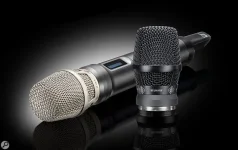
Neumann A-series and U-series wireless capsules split by transmitter ecosystem, with A models for Sennheiser and U models for supported third-party systems. The names look almost interchangeable, but picking the wrong suffix can leave you shopping for a capsule that was never listed for your handheld transmitter. Easy mistake.
The current Neumann Sennheiser capsule range includes the cardioid KK 104 A and supercardioid KK 105 A. Neumann’s U-series mirrors those two pickup choices with the KK 104 U and KK 105 U, except the compatible transmitter families change.
U-series heads are aimed at third-party wireless systems instead. Neumann lists Shure Axient Digital, ULX-D, QLX-D, and SLX-D, plus all Sony models, Mipro ACT Series, and all Lectrosonics models for the KK 104 U and KK 105 U. An older Shure transmitter missing from that list should not be treated as officially supported just because another Shure family appears there.
The hardware distinction matters because a detachable microphone head has to meet the transmitter mechanically and electrically before sound quality enters the conversation. A Sennheiser detachable microphone head interface describes the physical job of connecting a microphone head to a housing, which is a good reason not to treat A and U as cosmetic labels.
A shared model number tells you the pickup family, not universal fit. Treat the suffix as part of the model name whenever you order a spare.
Mixed rental inventories make the naming problem worse. A case label that says only “104” or “105” leaves out the part that decides which transmitter family the head belongs to, so A or U needs to stay attached to the model name in paperwork and spares. Tiny suffix, expensive confusion.
The outer dimensions can fool you too. Neumann publishes 48 mm diameter and 80 mm length for all four current heads, yet the listed transmitter support remains split between A and U. Matching size is useful for stage handling and case space, not proof of cross-family attachment or operation. Treat the compatibility table as the starting point, not the tape measure.
The cardioid KK 104 models are the easier fit when a performer moves around the grille or changes angle while singing. The supercardioid KK 105 models trade some of that forgiveness for tighter isolation from nearby instruments and stage sound. Switching from a Sennheiser transmitter to Shure does not suddenly make a cardioid singer need supercardioid.
Owners coming from older Sennheiser Neumann heads have another decision layered on top. The published A-series changes in handling noise and headroom matter if you are replacing a KK 204 or KK 205, but they do not turn the U-series into an upgrade path for the same transmitter.
Frequency range stays at 40 Hz to 20 kHz across the current A and U models. Each family also keeps Neumann’s close-vocal approach with pop protection, shock mounting, and a fixed low-cut response intended to control proximity effect when a singer works right on the grille.
The supercardioid pair also diverges slightly. Neumann rates the KK 105 A at 3 mV/Pa, 20 dB-A equivalent noise, 74 dB A-weighted signal-to-noise ratio, and 154 dB maximum SPL, while the KK 105 U is listed at 4 mV/Pa, 21 dB-A, 73 dB, and 152 dB maximum SPL.
Those differences are small enough that transmitter compatibility should still come first, but they kill the idea that A and U are literally the same capsule with a different letter stamped on the box. Gain staging can also land differently because the U models publish higher sensitivity, so copying transmitter gain settings between families is not a sensible starting assumption.
For a Sennheiser Spectera, EW-D, EW-DX, or Digital 6000/9000 handheld, start with A-series. For the specifically listed Shure, Sony, Mipro, or Lectrosonics systems, start with U-series, then choose 104 or 105 from the stage pattern you actually need.
The current Neumann Sennheiser capsule range includes the cardioid KK 104 A and supercardioid KK 105 A. Neumann’s U-series mirrors those two pickup choices with the KK 104 U and KK 105 U, except the compatible transmitter families change.
The suffix tells you which wireless system fits
A-series models are the Sennheiser side of the split. Neumann currently lists Spectera, EW-D, EW-DX, and Digital 6000/9000 handheld transmitters for the KK 104 A and KK 105 A, while the Spectera SKM supports both A-series heads alongside older Neumann capsules.U-series heads are aimed at third-party wireless systems instead. Neumann lists Shure Axient Digital, ULX-D, QLX-D, and SLX-D, plus all Sony models, Mipro ACT Series, and all Lectrosonics models for the KK 104 U and KK 105 U. An older Shure transmitter missing from that list should not be treated as officially supported just because another Shure family appears there.
The hardware distinction matters because a detachable microphone head has to meet the transmitter mechanically and electrically before sound quality enters the conversation. A Sennheiser detachable microphone head interface describes the physical job of connecting a microphone head to a housing, which is a good reason not to treat A and U as cosmetic labels.
A shared model number tells you the pickup family, not universal fit. Treat the suffix as part of the model name whenever you order a spare.
Mixed rental inventories make the naming problem worse. A case label that says only “104” or “105” leaves out the part that decides which transmitter family the head belongs to, so A or U needs to stay attached to the model name in paperwork and spares. Tiny suffix, expensive confusion.
The outer dimensions can fool you too. Neumann publishes 48 mm diameter and 80 mm length for all four current heads, yet the listed transmitter support remains split between A and U. Matching size is useful for stage handling and case space, not proof of cross-family attachment or operation. Treat the compatibility table as the starting point, not the tape measure.
The acoustic choices stay familiar across both families
Choosing 104 versus 105 is a separate decision from choosing A versus U. Both KK 104 versions are cardioid, while both KK 105 versions are supercardioid, so the singer’s movement, stage spill, and monitor geometry still decide which pattern makes more sense.The cardioid KK 104 models are the easier fit when a performer moves around the grille or changes angle while singing. The supercardioid KK 105 models trade some of that forgiveness for tighter isolation from nearby instruments and stage sound. Switching from a Sennheiser transmitter to Shure does not suddenly make a cardioid singer need supercardioid.
Owners coming from older Sennheiser Neumann heads have another decision layered on top. The published A-series changes in handling noise and headroom matter if you are replacing a KK 204 or KK 205, but they do not turn the U-series into an upgrade path for the same transmitter.
Frequency range stays at 40 Hz to 20 kHz across the current A and U models. Each family also keeps Neumann’s close-vocal approach with pop protection, shock mounting, and a fixed low-cut response intended to control proximity effect when a singer works right on the grille.
Published specs make A and U more than connector twins
The KK 104 A is rated at 3 mV/Pa sensitivity, 20 dB-A equivalent noise, and 154 dB maximum SPL. The KK 104 U is more sensitive at 4.8 mV/Pa, keeps the same 20 dB-A equivalent-noise figure, and is rated for 150 dB maximum SPL. Same cardioid job, different published electrical and headroom numbers.The supercardioid pair also diverges slightly. Neumann rates the KK 105 A at 3 mV/Pa, 20 dB-A equivalent noise, 74 dB A-weighted signal-to-noise ratio, and 154 dB maximum SPL, while the KK 105 U is listed at 4 mV/Pa, 21 dB-A, 73 dB, and 152 dB maximum SPL.
Those differences are small enough that transmitter compatibility should still come first, but they kill the idea that A and U are literally the same capsule with a different letter stamped on the box. Gain staging can also land differently because the U models publish higher sensitivity, so copying transmitter gain settings between families is not a sensible starting assumption.
For a Sennheiser Spectera, EW-D, EW-DX, or Digital 6000/9000 handheld, start with A-series. For the specifically listed Shure, Sony, Mipro, or Lectrosonics systems, start with U-series, then choose 104 or 105 from the stage pattern you actually need.