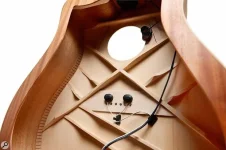
Baggs says HiFi DNA reaches feedback resistance comparable to its Element under-saddle pickup, not greater gain before feedback. The distinction matters because some launch coverage makes the new system sound almost immune to loud-stage problems when the manufacturer is making a narrower claim.
HiFi DNA is unusual because its sensors sit on the bridge plate rather than under the saddle. Baggs built the system around a more responsive bridge-plate design while still targeting the kind of feedback resistance associated with its Element. Those are two different goals packed into one pickup.
“Comparable” is the important word. Baggs does not publish a decibel figure showing DNA beating the Element, and the pickup itself has only volume and tone controls. There is no onboard notch filter, phase switch, or automatic feedback suppressor hiding inside the soundhole control.
A feedback-suppression experiment on amplified acoustic guitars modeled the guitar and acoustic loop together and achieved 7 dB more output before instability using active control. HiFi DNA does not use the system from that paper, but the experiment is useful context for one reason. Feedback depends on the complete amplified setup, not the pickup alone.
Baggs qualifies its own answer by saying there are many variables to consider before describing DNA as comparable with the Element. Fair enough. A quiet solo set through front-of-house speakers creates a very different feedback environment from a rock stage with drums, guitar amps, subs, and a loud wedge close to the instrument.
The HiFi DNA acoustic pickup system should therefore not be read as an automatic increase in maximum stage volume. Baggs is claiming that its bridge-plate design can retain feedback resistance comparable to the Element while pursuing a more natural, responsive direct sound.
In-ear monitoring removes the guitar feed from a floor wedge altogether. It does not make the PA incapable of exciting the guitar, but it removes one nearby loudspeaker from the stage loop. On cramped stages, that can materially change how much usable acoustic-guitar level you have before feedback begins.
Phase is another practical control. Baggs’ Session DI and Venue DI documentation tells players to try both polarity settings because one position will usually provide better feedback resistance, and the useful setting can change with your position onstage. HiFi DNA has no polarity switch of its own, so this remains an external job.
Gain structure matters too. Excessive monitor level can push the guitar toward instability and leave the engineer cutting large chunks of the sound with EQ just to keep the system quiet. A lower wedge level can preserve more of the pickup’s tonal balance before any corrective filtering is needed.
Polarity inversion can be worth trying before a deep EQ cut. Changing polarity alters the relationship between the amplified signal and the guitar at a particular stage position, and Baggs specifically notes that one setting usually offers better feedback resistance. The preferred setting may change when you move, which is why a setting from one venue is not guaranteed to behave the same way at the next.
HiFi DNA also lacks the dedicated feedback controls built into Baggs’ StagePro Element. StagePro Element combines its under-saddle pickup with phase inversion and a Garrett Null notch filter on the guitar itself, while DNA keeps its soundhole interface to volume and tone. Players using DNA on loud, wedge-heavy stages therefore get the pickup’s inherent feedback resistance first, with any surgical feedback control coming later in the signal chain.
HiFi DNA is unusual because its sensors sit on the bridge plate rather than under the saddle. Baggs built the system around a more responsive bridge-plate design while still targeting the kind of feedback resistance associated with its Element. Those are two different goals packed into one pickup.
“Comparable” is the important word. Baggs does not publish a decibel figure showing DNA beating the Element, and the pickup itself has only volume and tone controls. There is no onboard notch filter, phase switch, or automatic feedback suppressor hiding inside the soundhole control.
The Element comparison defines the claim
Gain before feedback is the usable level you can reach before the amplified signal feeds enough energy back into the guitar for the loop to become unstable. On an acoustic instrument, the body and strings can join that loop, so the threshold changes with the guitar, speaker position, room, stage volume, and monitoring setup.A feedback-suppression experiment on amplified acoustic guitars modeled the guitar and acoustic loop together and achieved 7 dB more output before instability using active control. HiFi DNA does not use the system from that paper, but the experiment is useful context for one reason. Feedback depends on the complete amplified setup, not the pickup alone.
Baggs qualifies its own answer by saying there are many variables to consider before describing DNA as comparable with the Element. Fair enough. A quiet solo set through front-of-house speakers creates a very different feedback environment from a rock stage with drums, guitar amps, subs, and a loud wedge close to the instrument.
The HiFi DNA acoustic pickup system should therefore not be read as an automatic increase in maximum stage volume. Baggs is claiming that its bridge-plate design can retain feedback resistance comparable to the Element while pursuing a more natural, responsive direct sound.
Stage geometry still changes the result
Monitor placement can change the result before you touch an EQ. A wedge sending a strong acoustic-guitar signal back toward the instrument gives the guitar more energy to absorb, especially around resonant frequencies. Moving the wedge, reducing its level, or changing where you stand can alter the feedback loop enough to stop a problem that first looked like a pickup fault.In-ear monitoring removes the guitar feed from a floor wedge altogether. It does not make the PA incapable of exciting the guitar, but it removes one nearby loudspeaker from the stage loop. On cramped stages, that can materially change how much usable acoustic-guitar level you have before feedback begins.
Phase is another practical control. Baggs’ Session DI and Venue DI documentation tells players to try both polarity settings because one position will usually provide better feedback resistance, and the useful setting can change with your position onstage. HiFi DNA has no polarity switch of its own, so this remains an external job.
Gain structure matters too. Excessive monitor level can push the guitar toward instability and leave the engineer cutting large chunks of the sound with EQ just to keep the system quiet. A lower wedge level can preserve more of the pickup’s tonal balance before any corrective filtering is needed.
Narrow feedback control still belongs outside the pickup
A narrow notch filter is useful when one resonant frequency starts ringing. Baggs includes this kind of control on the Session DI, Venue DI, and StagePro Element, but not on HiFi DNA itself. An external preamp or mixer with a sweepable notch can cut the problem frequency much more precisely than rolling down the pickup’s broad tone control.Polarity inversion can be worth trying before a deep EQ cut. Changing polarity alters the relationship between the amplified signal and the guitar at a particular stage position, and Baggs specifically notes that one setting usually offers better feedback resistance. The preferred setting may change when you move, which is why a setting from one venue is not guaranteed to behave the same way at the next.
HiFi DNA also lacks the dedicated feedback controls built into Baggs’ StagePro Element. StagePro Element combines its under-saddle pickup with phase inversion and a Garrett Null notch filter on the guitar itself, while DNA keeps its soundhole interface to volume and tone. Players using DNA on loud, wedge-heavy stages therefore get the pickup’s inherent feedback resistance first, with any surgical feedback control coming later in the signal chain.