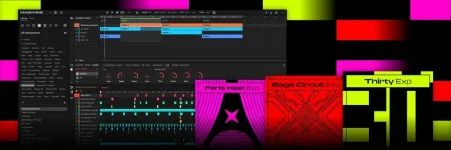
Maschine 3.7 adds a Euclidean sequencer with controls for steps, fills, rotation, and a Live mode that updates patterns during playback. Instead of placing every hit manually, you choose the cycle length and event count, then the generator spreads those events across the available steps as evenly as it can.
Steps set cycle length, fills set density, and rotation moves the result around the cycle without changing hit count. The Maschine 3.7 sequencing update puts this beside Random Note Generator and per-note probability, but those tools solve separate problems.
Once the Euclidean sequencer in Maschine gives you something useful, treat it as editable material. Generate less than you think you need, hear it against a fixed kick or snare, then adjust one control at a time.
Start with percussion because the effect is easy to hear. A sparse Euclidean step sequencer pattern on hats, rims, or short percussion can create motion around a conventional backbeat without rewriting the backbone of the groove. Raising fills changes density, not merely complexity, so a pattern that feels weak often needs fewer or better placed events rather than more of them.
Rotation is a different control. It shifts where the generated pattern starts, which can turn a rhythm that fights the downbeat into one that sits around it without changing its internal spacing. The distinction is clearer in Euclidean rotation across multiple voices, where rotation changes attack placement while leaving onset count alone. Thinking of rotation this way also makes a Euclidean gate sequencer or Euclidean MIDI sequencer easier to understand.
A Euclidean sequencer generator can become a slot machine if every control keeps moving. Keeping manual anchors beside generated hits gives the ear something stable to follow. A straight kick, clap, or bass pulse can stay fixed while the generated part supplies the movement around it.
Maschine's per-note probability control belongs later in the process. Probability can make selected notes appear less predictably, but it cannot rescue bad placement. Get the Euclidean pattern working first, then use chance on secondary hits if repetition feels too rigid. The same rule helps with Maschine note editing and Maschine note repeat. Placement, density, repetition, and probability are easier to judge when you change them separately.
The Maschine MK3 step sequencer workflow also benefits from resisting the urge to regenerate immediately. Hardware makes quick variation tempting, but a good take often needs a small edit rather than another roll. Maschine step mode remains useful for deliberate changes after the generator has done the boring distribution work.
A Native Instruments Maschine step sequencer pattern does not need to sound mathematical just because the generation method is mathematical. Short envelopes, clear transients, and modest fill counts make changes easier to judge. A dense sound with long decay can smear several evenly spaced attacks together and make a clean pattern feel busier than it is.
The same basic method travels well to other tools. A Euclidean sequencing workflow with MIDI output can separate generation from arrangement, letting the initial pattern become ordinary editable notes later. Inside Maschine 3.7, the equivalent mindset is to stop treating the first generated result as sacred. Set steps, choose a restrained fill count, rotate for placement, audition in Live mode, and only then add probability or manual edits.
Steps set cycle length, fills set density, and rotation moves the result around the cycle without changing hit count. The Maschine 3.7 sequencing update puts this beside Random Note Generator and per-note probability, but those tools solve separate problems.
Once the Euclidean sequencer in Maschine gives you something useful, treat it as editable material. Generate less than you think you need, hear it against a fixed kick or snare, then adjust one control at a time.
Steps and fills set the rhythm before rotation
The Euclidean sequencer algorithm becomes obvious with a 16-step cycle. Four fills can land at regular four-step intervals, while five fills cannot divide 16 evenly, so the gaps have to vary while remaining as balanced as possible. Godfried Toussaint's work on evenly distributed rhythmic onsets describes the mathematical family behind this kind of pattern generation.Start with percussion because the effect is easy to hear. A sparse Euclidean step sequencer pattern on hats, rims, or short percussion can create motion around a conventional backbeat without rewriting the backbone of the groove. Raising fills changes density, not merely complexity, so a pattern that feels weak often needs fewer or better placed events rather than more of them.
Rotation is a different control. It shifts where the generated pattern starts, which can turn a rhythm that fights the downbeat into one that sits around it without changing its internal spacing. The distinction is clearer in Euclidean rotation across multiple voices, where rotation changes attack placement while leaving onset count alone. Thinking of rotation this way also makes a Euclidean gate sequencer or Euclidean MIDI sequencer easier to understand.
Live mode is for finding the useful version
Live mode matters because you can hear changes while the loop runs instead of stopping to regenerate every small variation. Use it as an audition tool. Change fills until the density feels right, move rotation until the accents sit properly, then stop touching controls long enough to judge whether the groove actually improved.A Euclidean sequencer generator can become a slot machine if every control keeps moving. Keeping manual anchors beside generated hits gives the ear something stable to follow. A straight kick, clap, or bass pulse can stay fixed while the generated part supplies the movement around it.
Maschine's per-note probability control belongs later in the process. Probability can make selected notes appear less predictably, but it cannot rescue bad placement. Get the Euclidean pattern working first, then use chance on secondary hits if repetition feels too rigid. The same rule helps with Maschine note editing and Maschine note repeat. Placement, density, repetition, and probability are easier to judge when you change them separately.
The Maschine MK3 step sequencer workflow also benefits from resisting the urge to regenerate immediately. Hardware makes quick variation tempting, but a good take often needs a small edit rather than another roll. Maschine step mode remains useful for deliberate changes after the generator has done the boring distribution work.
Keep one rhythmic reference while the pattern moves
Euclidean patterns get more interesting when different cycles interact, but several moving parts can erase the groove's center. Independent pattern lengths against a fixed host clock show why one obvious reference part helps when shorter or stranger cycles move around it. Keep the kick plain, then let one percussion lane carry the less regular spacing.A Native Instruments Maschine step sequencer pattern does not need to sound mathematical just because the generation method is mathematical. Short envelopes, clear transients, and modest fill counts make changes easier to judge. A dense sound with long decay can smear several evenly spaced attacks together and make a clean pattern feel busier than it is.
The same basic method travels well to other tools. A Euclidean sequencing workflow with MIDI output can separate generation from arrangement, letting the initial pattern become ordinary editable notes later. Inside Maschine 3.7, the equivalent mindset is to stop treating the first generated result as sacred. Set steps, choose a restrained fill count, rotate for placement, audition in Live mode, and only then add probability or manual edits.