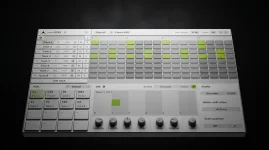
Rapid Flow's omniGRID offers 16 MIDI tracks and patterns up to 64 steps, while miniGRID is limited to four lanes and 32 steps. On paper, omniGRID simply looks larger, but track count is only useful when your patterns actually need the extra room.
miniGRID is still the cleaner fit for someone who wants to program a kick, snare, hat, and one extra percussion voice, then adjust their placement against the beat. Its four lanes keep the whole rhythm visible, and each lane can be shifted by up to 64 ms while the global Omniclock shuffle changes the feel across the pattern.
The jump to the new 16-track omniGRID sequencer matters once four lanes start forcing compromises. If your drum pattern needs separate closed and open hats, claps, rims, toms, percussion, bass notes, and a small arp, omniGRID lets those parts remain independent instead of squeezing several jobs into a smaller grid.
Its simplicity also reduces the temptation to keep decorating a beat after the groove is already working. You get four MIDI lanes, per-lane timing shift, shuffle, mute and solo controls, velocity shaping, adjustable sequence length, and direct MIDI routing. For a drum loop built from a few essential voices, more lanes can become administration rather than freedom.
Timing deserves restraint too. Controlled listening work on expert microtiming and perceived groove found that exaggerated deviations reduced groove ratings, while fully quantized timing and the original expert performances could both rate highly. A 64 ms shift range is therefore creative headroom, not a target you need to use.
You feel the split once one pattern contains several kinds of motion at once. You might want a steady kick, a seven-step percussion cycle, a hat generated from Euclidean pulses, a bass phrase running a longer sequence, and an arp constrained to a chosen key. miniGRID can handle some of those notes, but it does not provide the same independent pattern architecture or melodic controls.
Longer patterns matter for the same reason. Thirty-two steps already covers plenty of conventional drum programming, especially when repetition is part of the style. Sixty-four steps become valuable when you want a fill, accent, probability change, or melodic variation to appear less often without drawing the whole idea into the DAW first.
omniGRID becomes more convincing when the sequencer itself is expected to compose variation. Probability can thin selected hits, repeats can create bursts, scale locking can keep interval changes inside a chosen key, and Euclidean generation can produce a rhythmic starting point before you manually edit it. Independent track lengths also let several cycles move against each other without duplicating clips across a DAW timeline.
Price reinforces the split rather than settling it. Rapid Flow currently lists miniGRID at $29 and omniGRID at $79, with a fully functional 45-day trial offered for both. Paying the difference makes sense when you repeatedly need the extra tracks, longer patterns, per-step variation, Euclidean tools, or scale-aware melodic sequencing.
There is also a practical reason not to upgrade automatically. Both plugins send MIDI rather than generate audio, so the quality of the final result still depends on the instrument receiving those notes and on how your DAW handles the routing. Rapid Flow also warns that instruments that quantize incoming MIDI can interfere with timing shifts and shuffle, meaning a larger sequencer cannot fix a receiving instrument that keeps snapping its input back to the grid.
miniGRID is still the cleaner fit for someone who wants to program a kick, snare, hat, and one extra percussion voice, then adjust their placement against the beat. Its four lanes keep the whole rhythm visible, and each lane can be shifted by up to 64 ms while the global Omniclock shuffle changes the feel across the pattern.
The jump to the new 16-track omniGRID sequencer matters once four lanes start forcing compromises. If your drum pattern needs separate closed and open hats, claps, rims, toms, percussion, bass notes, and a small arp, omniGRID lets those parts remain independent instead of squeezing several jobs into a smaller grid.
miniGRID stays useful when timing is the main job
miniGRID makes sense when you already like your notes and mainly want to alter how they sit in time. Velocity editing and MIDI export were added in version 1.1.2, so the plugin is no longer limited to static accents or patterns trapped inside its own window. It can still be a quick sketchpad rather than a miniature arrangement system.Its simplicity also reduces the temptation to keep decorating a beat after the groove is already working. You get four MIDI lanes, per-lane timing shift, shuffle, mute and solo controls, velocity shaping, adjustable sequence length, and direct MIDI routing. For a drum loop built from a few essential voices, more lanes can become administration rather than freedom.
Timing deserves restraint too. Controlled listening work on expert microtiming and perceived groove found that exaggerated deviations reduced groove ratings, while fully quantized timing and the original expert performances could both rate highly. A 64 ms shift range is therefore creative headroom, not a target you need to use.
omniGRID earns its space through independent movement
omniGRID changes the decision because its tracks can behave differently from one another. A lane can have its own pattern length, Euclidean pulse structure, timing position, and shuffle treatment, while individual steps can carry velocity, note length, timing shift, probability, repeats, and interval changes. Those controls create movement inside the sequence rather than merely moving the whole lane earlier or later.You feel the split once one pattern contains several kinds of motion at once. You might want a steady kick, a seven-step percussion cycle, a hat generated from Euclidean pulses, a bass phrase running a longer sequence, and an arp constrained to a chosen key. miniGRID can handle some of those notes, but it does not provide the same independent pattern architecture or melodic controls.
Longer patterns matter for the same reason. Thirty-two steps already covers plenty of conventional drum programming, especially when repetition is part of the style. Sixty-four steps become valuable when you want a fill, accent, probability change, or melodic variation to appear less often without drawing the whole idea into the DAW first.
The better choice depends on what you want to remain editable
A producer working mostly with compact drum grooves may move faster in miniGRID because the important decisions stay exposed. You can adjust timing, velocity, shuffle, and note placement without maintaining sixteen possible lanes or six per-step parameter views. Small tools often survive in templates because opening them does not create another editing session.omniGRID becomes more convincing when the sequencer itself is expected to compose variation. Probability can thin selected hits, repeats can create bursts, scale locking can keep interval changes inside a chosen key, and Euclidean generation can produce a rhythmic starting point before you manually edit it. Independent track lengths also let several cycles move against each other without duplicating clips across a DAW timeline.
Price reinforces the split rather than settling it. Rapid Flow currently lists miniGRID at $29 and omniGRID at $79, with a fully functional 45-day trial offered for both. Paying the difference makes sense when you repeatedly need the extra tracks, longer patterns, per-step variation, Euclidean tools, or scale-aware melodic sequencing.
There is also a practical reason not to upgrade automatically. Both plugins send MIDI rather than generate audio, so the quality of the final result still depends on the instrument receiving those notes and on how your DAW handles the routing. Rapid Flow also warns that instruments that quantize incoming MIDI can interfere with timing shifts and shuffle, meaning a larger sequencer cannot fix a receiving instrument that keeps snapping its input back to the grid.