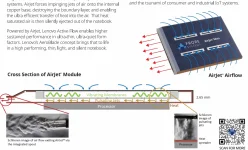
Frore introduced AirJet Mini Slim in January 2024 with an automatic self-cleaning mode that reverses the cooling module’s airflow. The cleaning targets its dust filters. Not every surface inside your laptop.
Removing bottom vents from Lenovo’s slim AirJet laptop concept changes the airflow layout, but it does not make the computer sealed. Keeping the cooling chip clean and keeping dirt out of the computer are different jobs.
An AirJet label won’t tell you whether both are fitted. Frore says its 1,750 pascals of backpressure allow designers to use protective filters, but the laptop maker still chooses the enclosure’s filtration.
For dust control across the whole laptop, filter placement matters as much as the presence of a filter. Air entering through an unfiltered opening could carry particles past it. You’d need the actual intake layout to judge the protection.
Mini Slim’s launch description specifically names the AirJet dust filters as the surfaces cleared by reversed airflow. It does not establish that separate filters elsewhere in the computer receive the same cleaning action.
Consider a design with a filter over a side intake and an AirJet module farther inside. Dust stopped at the side intake never reaches the module. A successful cleaning cycle at the module would not, on its own, demonstrate that the outer filter was clear.
The models might share cleaning features, but you can’t assume every version runs the same routine. Mini Slim’s description names reversed airflow. G2’s particle-ejection claim leaves the precise routine unstated.
Mini G2’s product description gives no cleaning-cycle duration or user command for starting one. Switching a laptop off and on is not a documented cleaning method in that description.
Mini Slim’s announcement says its self-cleaning feature is also available for the original AirJet Mini. Availability doesn’t tell you whether a particular device enables it or gives you control over it. Those details belong in the laptop’s own support instructions.
Frore’s descriptions give you no safe distance for a compressed-air nozzle or instructions for wiping an exposed filter. Automatic cleaning inside the module doesn’t establish that either manual method is appropriate.
Particle size does not tell you how much dust a filter can hold before needing attention. It also does not establish how much airflow remains after prolonged exposure.
You could have a filter that catches fine particles effectively yet needs care once enough material accumulates. Catching dust and disposing of it are separate requirements. The 0.3-micron statement does not supply a replacement interval or promise unlimited dust capacity.
Frore has also said its internal reliability testing supported a five-year lifetime for AirJet. Its CTO described additional performance and reliability testing by customers, but neither statement supplies a cleaning schedule for an entire laptop.
The reliability statement does not give the dust mixture, concentration, exposure duration, or cooling performance before and after testing. Five years is a service-life claim, not five years of published observations from someone’s dusty home office. It can’t tell you when to clean a particular machine.
A useful dust test would include the complete laptop enclosure, with its normal filters fitted and its cover closed. Testing a loose cooling module, or leaving its enclosure open during testing, would omit the restrictions created by the assembled case.
Removing an intake filter to improve a test result would change the protection being evaluated. Any cooling advantage measured that way would belong to the altered machine, not the filtered configuration you expected.
Recording the amount of dust captured at the enclosure filter separately from dust entering the cooler would help identify where maintenance might be needed. Before-and-after tests should keep room temperature and processor heat output constant, then measure any rise in processor temperature. An AirJet module could stay internally clear while accumulated dirt at an upstream filter restricts its air supply.
Removing bottom vents from Lenovo’s slim AirJet laptop concept changes the airflow layout, but it does not make the computer sealed. Keeping the cooling chip clean and keeping dirt out of the computer are different jobs.
The cooler’s filter is only part of the job
Frore describes filters on the AirJet module and additional filters at the device’s air inlets. The first protects the cooler’s intake. The second can intercept particles before they travel through the enclosure, provided the incoming air actually passes through it.An AirJet label won’t tell you whether both are fitted. Frore says its 1,750 pascals of backpressure allow designers to use protective filters, but the laptop maker still chooses the enclosure’s filtration.
For dust control across the whole laptop, filter placement matters as much as the presence of a filter. Air entering through an unfiltered opening could carry particles past it. You’d need the actual intake layout to judge the protection.
Mini Slim’s launch description specifically names the AirJet dust filters as the surfaces cleared by reversed airflow. It does not establish that separate filters elsewhere in the computer receive the same cleaning action.
Consider a design with a filter over a side intake and an AirJet module farther inside. Dust stopped at the side intake never reaches the module. A successful cleaning cycle at the module would not, on its own, demonstrate that the outer filter was clear.
Mini G2 makes a different dust claim
Frore says AirJet Mini G2 can eject particles entering the module without clogging or losing performance. Its product description also says it can draw air through dustproof and water-resistant filters.The models might share cleaning features, but you can’t assume every version runs the same routine. Mini Slim’s description names reversed airflow. G2’s particle-ejection claim leaves the precise routine unstated.
Mini G2’s product description gives no cleaning-cycle duration or user command for starting one. Switching a laptop off and on is not a documented cleaning method in that description.
Mini Slim’s announcement says its self-cleaning feature is also available for the original AirJet Mini. Availability doesn’t tell you whether a particular device enables it or gives you control over it. Those details belong in the laptop’s own support instructions.
Frore’s descriptions give you no safe distance for a compressed-air nozzle or instructions for wiping an exposed filter. Automatic cleaning inside the module doesn’t establish that either manual method is appropriate.
A particle rating is not a cleaning schedule
iodyne’s Pro Mini portable SSD uses two AirJet modules and advertises protection from particles as small as 0.3 microns. The number describes that drive’s cooling system. Applying it to a laptop just because both use AirJet would skip the enclosure and filter differences.Particle size does not tell you how much dust a filter can hold before needing attention. It also does not establish how much airflow remains after prolonged exposure.
You could have a filter that catches fine particles effectively yet needs care once enough material accumulates. Catching dust and disposing of it are separate requirements. The 0.3-micron statement does not supply a replacement interval or promise unlimited dust capacity.
Frore has also said its internal reliability testing supported a five-year lifetime for AirJet. Its CTO described additional performance and reliability testing by customers, but neither statement supplies a cleaning schedule for an entire laptop.
The reliability statement does not give the dust mixture, concentration, exposure duration, or cooling performance before and after testing. Five years is a service-life claim, not five years of published observations from someone’s dusty home office. It can’t tell you when to clean a particular machine.
A useful dust test would include the complete laptop enclosure, with its normal filters fitted and its cover closed. Testing a loose cooling module, or leaving its enclosure open during testing, would omit the restrictions created by the assembled case.
Removing an intake filter to improve a test result would change the protection being evaluated. Any cooling advantage measured that way would belong to the altered machine, not the filtered configuration you expected.
Recording the amount of dust captured at the enclosure filter separately from dust entering the cooler would help identify where maintenance might be needed. Before-and-after tests should keep room temperature and processor heat output constant, then measure any rise in processor temperature. An AirJet module could stay internally clear while accumulated dirt at an upstream filter restricts its air supply.