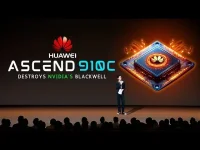
China's Huawei claims its Ascend 910C chips match NVIDIA's H100 GPUs in performance. This news briefly hurt NVIDIA's stock price as markets reacted to the announcement. Mizuho analyst Vijay Rakesh estimates China might make over 700,000 Ascend units in 2025. He notes the chip's face production challenges at SMIC, with only about a 30% success rate. These chips represent a major step for China's tech industry.
The Ascend 910C combines two older 910B chips to achieve 800 TFLOP/s computing power at FP16. It offers memory bandwidth up to 3.2 TB/s, similar to NVIDIA's H100. SMIC makes these chips using 7nm DUV technology, which explains the low production success. Huawei has expanded to control 11 different chip factories across China. Many use different names to hide their connection to Huawei.
Reports indicate Huawei works with SiCarrier to create advanced chip-making machines. Success would free China from relying on foreign technology. The US government recently restricted NVIDIA's H20 and AMD's MI308 chips made for China. New US rules state that using Huawei's Ascend 910 chips anywhere violates export controls. These measures aim to limit Huawei's global reach.
The Ascend 910C combines two older 910B chips to achieve 800 TFLOP/s computing power at FP16. It offers memory bandwidth up to 3.2 TB/s, similar to NVIDIA's H100. SMIC makes these chips using 7nm DUV technology, which explains the low production success. Huawei has expanded to control 11 different chip factories across China. Many use different names to hide their connection to Huawei.
Reports indicate Huawei works with SiCarrier to create advanced chip-making machines. Success would free China from relying on foreign technology. The US government recently restricted NVIDIA's H20 and AMD's MI308 chips made for China. New US rules state that using Huawei's Ascend 910 chips anywhere violates export controls. These measures aim to limit Huawei's global reach.