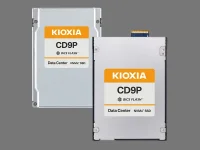
Kioxia rolled out their newest computer storage drive for big data centers that power artificial intelligence systems. The CD9P drive uses the company's latest flash memory technology to handle heavy workloads that AI servers throw at it. Data centers can pick between two versions based on how much they plan to write data each day.
The drive comes in different sizes and shapes to fit various server setups. One version measures 2.5 inches thick and holds up to 61 terabytes of data. The other uses a smaller design called EDSFF and stores up to 30 terabytes.
Speed improvements really stand out when compared to older models. Reading data hits 14.8 gigabytes per second, much faster than the previous 12 gigabytes per second. Writing data jumped from 5.5 to 7 gigabytes per second.
Random data operations got major upgrades for server tasks. Reading random data reaches 2.6 million operations per second, up from 2 million. Writing random data almost doubled to 750,000 operations per second from 400,000.
Power savings matter a lot in data centers that run thousands of drives. The new CD9P uses less electricity to move the same amount of data. Reading and writing operations became 60% and 45% more efficient respectively. Random operations improved even more, with reading gaining 55% efficiency and writing doubling its power performance.
The drive comes in different sizes and shapes to fit various server setups. One version measures 2.5 inches thick and holds up to 61 terabytes of data. The other uses a smaller design called EDSFF and stores up to 30 terabytes.
Speed improvements really stand out when compared to older models. Reading data hits 14.8 gigabytes per second, much faster than the previous 12 gigabytes per second. Writing data jumped from 5.5 to 7 gigabytes per second.
Random data operations got major upgrades for server tasks. Reading random data reaches 2.6 million operations per second, up from 2 million. Writing random data almost doubled to 750,000 operations per second from 400,000.
Power savings matter a lot in data centers that run thousands of drives. The new CD9P uses less electricity to move the same amount of data. Reading and writing operations became 60% and 45% more efficient respectively. Random operations improved even more, with reading gaining 55% efficiency and writing doubling its power performance.