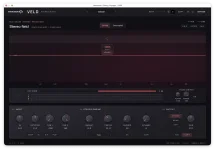
Marula Music has updated Spek and Veld, giving producers better control over saturation levels and stereo width. Spek 1.0.4 gets automatic volume correction, while Veld 1.1 lets each of its four frequency bands use a different stereo effect.
Veld's new decoupled mode is the big change here. Instead of making every band share one stereo engine, producers can pick Haas, Allpass, Velvet, or Chorus for each range. That means bass can stay centered while drums and high frequencies get their own width settings.
And there's more control over how the stereo field reacts. Each band can track its own transients, with fast or slow response options for dynamic width. Phase limiting also works on a band-by-band basis, with an adjustable correlation floor to help manage stereo behavior.
The interface gets a few handy tweaks as well. Users can check phase correlation for each band or view the final result across the full signal. Band markers, copy and paste controls, custom accent colors, saved color defaults, and clearer tooltips round out the update.
Spek takes a different route. Its new Auto Gain Control, or AGC, tracks volume before and after saturation, then corrects the output as settings change. Pretty useful for checking whether a sound has improved in tone rather than merely getting louder.
Unlike the older Auto feature, which pairs Drive with Trim and lets users set an offset, AGC reacts to changes across the processing chain. Character, Bias, and mid/side balance can all affect the level, and the new system adjusts for those shifts.
A small workflow tweak also lands in Spek. Double-clicking Trim lets users type an exact number, while both plugins receive minor fixes and performance tweaks.
Both releases are ready to use, with free demos available from Marula Music. Spek costs €49, and Veld goes for €69. Producers who want cleaner level checks or more detailed stereo control have fresh tools to try.