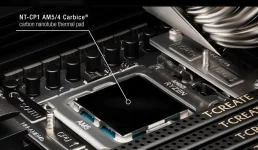
Noctua NT-CP1 AM5/4 may get better at cooling after a CPU has been through a bunch of heat cycles. That's the main pitch for this $24.95 pad, which Carbice Corporation helped make. Instead of paste, AMD Ryzen users get a thin sheet of carbon nanotubes that can adapt as the chip heats up and cools off.
The tech is quite neat. Tiny carbon tubes stand upright on an aluminum layer, with a special polymer film at the contact points. Over the first few hundred or even a few thousand heat cycles, the material can fit more snugly against rough spots on the CPU and cooler. At least, that's what Noctua claims.
Durability is the big deal here. Tests by the maker went past 100,000 heat cycles, and Noctua reckons the pad could last a decade or more in the right setup. That could spare users from having to clean off old paste and apply a fresh batch. Still, those lifespan claims need real-world proof.
Size is quite simple. At 33 by 33 mm, the pad is just 90 micrometers thick, or 0.09 mm. It fits AMD AM4 and AM5 chips, with a cutout shape meant to cover the key heat zone on Ryzen CPUs and APUs. Not a one-size-fits-all deal.
As for fitting it, users peel off one film, hold the pad on the chip for about ten seconds, then strip the other film and mount the cooler. The firm metal layer helps keep it flat. A mild tack from the polymer helps it stay put as well. Less mess than paste, for sure.
One catch is the electrical safety bit. Noctua says the coated contact faces won't pass current if the film stays intact. But a cut or puncture could change that. Treating the pad as fully insulated would be a bad call.
Carbice has some neat tech behind this as well. Its work has roots in heat control for spacecraft and satellites. The pads come from U.S. production, with reused aluminum and carbon taken from waste gas. Even the nanotube growth method uses fairly low heat.
But is it better than NT-H2 paste on day one? No clear answer yet. Noctua hasn't shared a fair set of head-to-head temperature tests. CPU wattage, heatsink pressure, and the cooler's base will all affect the result. Anyone chasing the best temps will need test data first.
Buyers can find the NT-CP1 through Noctua's official Amazon shops, with wider retail stock set to follow. The higher cost may make sense for users who hate routine paste swaps. For raw cooling gains, though, the jury is still out.