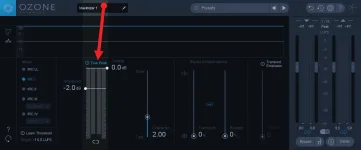
Ozone 12’s IRC 5 is the first Maximizer mode to apply separate gain envelopes across four frequency bands. IRC IV already reacts to frequency content, but its core limiting action still rides on a shared sample gain envelope.
IRC IV arrived with spectral shaping designed to reduce pumping and intermodulation when a particular part of the spectrum dominates a peak. It can focus more attenuation on troublesome frequency regions instead of making every part of the mix pay equally. Still, the whole signal remains tied together by the main gain envelope.
IRC 5 changes the architecture rather than merely refining the release curve. True Peak remains a separate control, so Ozone Maximizer oversampling behavior should not be confused with choosing between IRC IV and IRC 5.
The important detail is what happens after the spectral analysis. IRC IV still depends on one shared gain envelope for the sample stream, so a large event in one area can influence everything else even when spectral shaping reduces the damage. You hear the limitation most clearly when deep bass, sustained vocals, and sharp percussion arrive together.
This is also why IRC IV can still sound excellent at moderate gain reduction. Its processing keeps the mix moving as one object, and the Classic, Modern, and Transient styles give you different ways to bias the release behavior. On a balanced mix, that cohesion can be more attractive than squeezing out another fraction of perceived loudness.
IRC IV becomes less comfortable when one frequency range repeatedly forces the limiter to work hard. A long 808 note can keep the shared envelope busy while a snare, vocal consonant, or bright percussion lands above it. Spectral shaping helps, but it cannot fully separate those competing timing demands.
Separate envelopes also allow different attack and release behavior across frequency ranges. Low bass does not need to recover at the same speed as a snare crack or a dense patch of cymbals, and forcing them into one timing decision is where broadband limiting starts to sound cramped. IRC 5 has more room to make those decisions independently.
The idea fits the broader psychoacoustic approach behind Ozone’s limiter family. An iZotope psychoacoustic audio limiter design describes evaluating distortion against masking thresholds across critical frequency bands rather than treating every error as equally audible. IRC 5 is not simply the patent dropped into a newer plugin, but the design philosophy explains why perceptual audibility matters as much as raw peak control.
There is a trade-off. Independent frequency-band attenuation can alter tonal balance for a moment because one region may be reduced more than another, and iZotope explicitly treats this as something the algorithm must balance against pumping and intermodulation. Cleaner does not automatically mean more tonally neutral in every passage.
Listen to the vocal and cymbals when the kick or sub hits. If IRC IV makes those elements dip, blur, or breathe with the low end, IRC 5 has a structural advantage because the offending band can take more of the reduction itself. If both modes stay composed, the newer algorithm has not solved a problem you actually have.
The reverse matters too. IRC IV can remain the better artistic choice when you like the way one gain contour glues the spectrum together, or when its Transient style keeps attacks feeling more convincing at the loudness you need. Mode selection should follow the failure you hear, not the version number printed beside the menu.
Push the threshold harder during the comparison than you expect to use in the final master. Moderate settings can hide the architectural difference, while heavier reduction reveals whether low-frequency energy is making the whole mix pump or whether IRC 5 is shifting the balance too obviously. Then back off until the problem disappears without throwing away the loudness you actually need.
IRC IV arrived with spectral shaping designed to reduce pumping and intermodulation when a particular part of the spectrum dominates a peak. It can focus more attenuation on troublesome frequency regions instead of making every part of the mix pay equally. Still, the whole signal remains tied together by the main gain envelope.
IRC 5 changes the architecture rather than merely refining the release curve. True Peak remains a separate control, so Ozone Maximizer oversampling behavior should not be confused with choosing between IRC IV and IRC 5.
IRC IV shapes peaks without becoming multiband
IRC IV can look surprisingly multiband in practice because its spectral shaping works across dozens of psychoacoustically spaced regions. A bass hit that creates most of a peak can receive more attention than a vocal sitting above it, which helps keep the vocal from ducking as heavily.The important detail is what happens after the spectral analysis. IRC IV still depends on one shared gain envelope for the sample stream, so a large event in one area can influence everything else even when spectral shaping reduces the damage. You hear the limitation most clearly when deep bass, sustained vocals, and sharp percussion arrive together.
This is also why IRC IV can still sound excellent at moderate gain reduction. Its processing keeps the mix moving as one object, and the Classic, Modern, and Transient styles give you different ways to bias the release behavior. On a balanced mix, that cohesion can be more attractive than squeezing out another fraction of perceived loudness.
IRC IV becomes less comfortable when one frequency range repeatedly forces the limiter to work hard. A long 808 note can keep the shared envelope busy while a snare, vocal consonant, or bright percussion lands above it. Spectral shaping helps, but it cannot fully separate those competing timing demands.
IRC 5 breaks the shared-envelope bottleneck
IRC 5 divides the limiting work across four frequency bands and can apply a different gain envelope in each one. Bands contributing most to the overall peak can be attenuated first, leaving other ranges less disturbed instead of dragging the entire mix through the same gain movement.Separate envelopes also allow different attack and release behavior across frequency ranges. Low bass does not need to recover at the same speed as a snare crack or a dense patch of cymbals, and forcing them into one timing decision is where broadband limiting starts to sound cramped. IRC 5 has more room to make those decisions independently.
The idea fits the broader psychoacoustic approach behind Ozone’s limiter family. An iZotope psychoacoustic audio limiter design describes evaluating distortion against masking thresholds across critical frequency bands rather than treating every error as equally audible. IRC 5 is not simply the patent dropped into a newer plugin, but the design philosophy explains why perceptual audibility matters as much as raw peak control.
There is a trade-off. Independent frequency-band attenuation can alter tonal balance for a moment because one region may be reduced more than another, and iZotope explicitly treats this as something the algorithm must balance against pumping and intermodulation. Cleaner does not automatically mean more tonally neutral in every passage.
Hard limiting exposes the real difference
Run both modes at the same ceiling, then match the perceived output level before deciding which one wins. IRC 5 often earns its keep when bass-heavy peaks make IRC IV pull the rest of the record down, especially on dense electronic, hip-hop, pop, or metal masters with busy upper detail.Listen to the vocal and cymbals when the kick or sub hits. If IRC IV makes those elements dip, blur, or breathe with the low end, IRC 5 has a structural advantage because the offending band can take more of the reduction itself. If both modes stay composed, the newer algorithm has not solved a problem you actually have.
The reverse matters too. IRC IV can remain the better artistic choice when you like the way one gain contour glues the spectrum together, or when its Transient style keeps attacks feeling more convincing at the loudness you need. Mode selection should follow the failure you hear, not the version number printed beside the menu.
Push the threshold harder during the comparison than you expect to use in the final master. Moderate settings can hide the architectural difference, while heavier reduction reveals whether low-frequency energy is making the whole mix pump or whether IRC 5 is shifting the balance too obviously. Then back off until the problem disappears without throwing away the loudness you actually need.