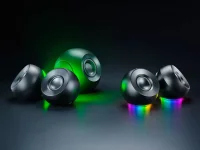
Razer’s original Mako launched worldwide in January 2008 as a 300-watt THX-certified 2.1 desktop speaker system priced at $399.99. The new Razer Mako speakers keep the rounded family look, but almost everything underneath has been rethought.
The old Razer Mako 2.1 was unusually ambitious for PC audio. Two bi-amplified satellites, a powered subwoofer, DSP control, ClassHD amplification, THX certification, and a claimed 25 Hz to 20 kHz frequency range put it closer to a small hi-fi experiment than the usual plastic computer-speaker bundle.
Razer is explicit about the revival not being a straight V2. The 2026 line borrows the shape and the Mako name, then swaps the original acoustic trickery for smaller full-range drivers, USB-C power, wireless connectivity, software surround, and Chroma lighting.
The THX ground-plane loudspeaker patent describes a driver facing a flat reflecting surface, with the output turned through a duct toward an aperture near the cabinet edge. Each original Razer Mako speaker was therefore doing something much stranger than simply pointing a conventional cone at your head.
Power was also on another scale. Razer rated the complete system at 300 watts, while each satellite used two 50-watt amplifier channels and the subwoofer handled the bottom end separately. Contemporary Razer Mako review coverage tended to focus on the huge bass, unusually clean presentation, high price, and the amount of desk space the system demanded.
Frequency figures need a little caution too. The original specification listed 25 Hz to 20 kHz overall, with a tighter plus or minus 2.5 dB window from 40 Hz to 18 kHz, while the 2026 Mako is simply rated down to 45 Hz. Those figures do not use the same published tolerance, so the endpoints alone cannot settle which system has deeper usable bass.
Control was very 2008. The Razer Mako control pod handled volume, bass, mute, line input, and headphone output instead of pushing those jobs into an app. Even the visual design of the Mako speakers was tied to the acoustic layout rather than RGB or software integration.
The current Razer desktop speakers also behave more like modern USB peripherals. If you need to connect Razer speakers to a PC, one USB-C connection on the new Mako can carry audio and power, while Bluetooth 5.3 and a 3.5 mm input cover phones and analog gear. Razer PC speakers with RGB are normal territory now, and rear-projection Chroma lighting gives the new Mako a visual job the original never had.
Razer’s PC speakers have also moved toward software-driven spatial effects across more than one product. The Razer Clio THX Spatial Audio system uses a very different form factor, while Audioscenic’s speaker-based 3D audio also shows how Razer has leaned into processing rather than relying on one fixed acoustic geometry.
Virtual surround still should not be confused with the original Ground Plane system. Binaural playback over speakers has its own problems because both loudspeakers reach both ears, so software widening and physical radiation control are solving different jobs.
Even the product split is new. Razer Mako X removes the separate subwoofer for a 2.0 layout with passive radiators, while the regular Mako keeps the dedicated sub for buyers specifically after Razer computer speakers with subwoofer bass.
The old system was expensive, heavy on custom acoustic engineering, and built around a wired desktop setup. The new one is built around easier connectivity, much lower published output figures, and Razer’s current lighting and spatial-audio ecosystem.
If you spot an original Razer Mako for sale, its appeal is now mostly about owning the strange THX-era engineering rather than buying an earlier version of today’s model. The name survived, but the engineering philosophy didn’t.
The old Razer Mako 2.1 was unusually ambitious for PC audio. Two bi-amplified satellites, a powered subwoofer, DSP control, ClassHD amplification, THX certification, and a claimed 25 Hz to 20 kHz frequency range put it closer to a small hi-fi experiment than the usual plastic computer-speaker bundle.
Razer is explicit about the revival not being a straight V2. The 2026 line borrows the shape and the Mako name, then swaps the original acoustic trickery for smaller full-range drivers, USB-C power, wireless connectivity, software surround, and Chroma lighting.
The old Mako was built around the desk itself
The clever bit in the Razer Mako THX design was the way the satellites used the surface under them. THX Ground Plane and Slot Speaker technology fired sound toward the desk and redirected it through a narrow opening, with the geometry intended to reduce the ugly reflection problems ordinary desktop speakers can create.The THX ground-plane loudspeaker patent describes a driver facing a flat reflecting surface, with the output turned through a duct toward an aperture near the cabinet edge. Each original Razer Mako speaker was therefore doing something much stranger than simply pointing a conventional cone at your head.
Power was also on another scale. Razer rated the complete system at 300 watts, while each satellite used two 50-watt amplifier channels and the subwoofer handled the bottom end separately. Contemporary Razer Mako review coverage tended to focus on the huge bass, unusually clean presentation, high price, and the amount of desk space the system demanded.
Frequency figures need a little caution too. The original specification listed 25 Hz to 20 kHz overall, with a tighter plus or minus 2.5 dB window from 40 Hz to 18 kHz, while the 2026 Mako is simply rated down to 45 Hz. Those figures do not use the same published tolerance, so the endpoints alone cannot settle which system has deeper usable bass.
Control was very 2008. The Razer Mako control pod handled volume, bass, mute, line input, and headphone output instead of pushing those jobs into an app. Even the visual design of the Mako speakers was tied to the acoustic layout rather than RGB or software integration.
The 2026 Mako is a different machine under the shell
The revived model uses two custom-tuned 2.75-inch full-range drivers with a dedicated forward-firing 3.5-inch subwoofer. Razer rates it at 40W RMS, 60W peak, and a 45 Hz low end, so comparing the new numbers directly with the old 300-watt headline is pretty misleading because the published power figures are framed differently.The current Razer desktop speakers also behave more like modern USB peripherals. If you need to connect Razer speakers to a PC, one USB-C connection on the new Mako can carry audio and power, while Bluetooth 5.3 and a 3.5 mm input cover phones and analog gear. Razer PC speakers with RGB are normal territory now, and rear-projection Chroma lighting gives the new Mako a visual job the original never had.
Razer’s PC speakers have also moved toward software-driven spatial effects across more than one product. The Razer Clio THX Spatial Audio system uses a very different form factor, while Audioscenic’s speaker-based 3D audio also shows how Razer has leaned into processing rather than relying on one fixed acoustic geometry.
Virtual surround still should not be confused with the original Ground Plane system. Binaural playback over speakers has its own problems because both loudspeakers reach both ears, so software widening and physical radiation control are solving different jobs.
The name survived more clearly than the engineering
Anyone expecting the 2026 model to be a modernized Razer Mako 2.1 with the old THX hardware inside is going to get the wrong picture. The 2026 Razer Mako and Mako X speaker lineup is really a new desktop-audio family wearing a familiar badge.Even the product split is new. Razer Mako X removes the separate subwoofer for a 2.0 layout with passive radiators, while the regular Mako keeps the dedicated sub for buyers specifically after Razer computer speakers with subwoofer bass.
The old system was expensive, heavy on custom acoustic engineering, and built around a wired desktop setup. The new one is built around easier connectivity, much lower published output figures, and Razer’s current lighting and spatial-audio ecosystem.
If you spot an original Razer Mako for sale, its appeal is now mostly about owning the strange THX-era engineering rather than buying an earlier version of today’s model. The name survived, but the engineering philosophy didn’t.