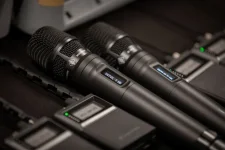
Sennheiser’s current Spectera specifications put mono mic and line latency as low as 1.0 ms, but the fastest modes allow eight links per RF carrier. Each of those links consumes 12.5 percent of the carrier, so the headline latency is also a resource decision. Fast is not free.
The practical wrinkle behind Spectera SKM’s 1 ms latency is that Spectera does not have one universal latency setting. Audio Link Modes let an engineer choose latency, codec, range, and RF utilization link by link, which changes how much work a 6 or 8 MHz carrier can actually do. A microphone that needs the minimum delay can therefore live beside another link configured for higher density.
Latency also matters beyond the RF spec sheet. In a controlled digital-instrument experiment, added performance latency changed how players rated and interacted with an instrument, with 20 ms and jittered 10 ms conditions rated worse than the zero-latency condition across several measures. Spectera’s 1.0 to 2.7 ms mic modes sit far below those test delays, but every millisecond still joins the rest of the console, conversion, processing, and monitoring path.
So a spec sheet saying “1 ms” does not tell you the expected coverage behavior by itself. Codec and link mode matter just as much, especially when a production has long antenna-to-performer distances or awkward RF geometry. Picking Raw Low Latency merely because PCM looks attractive on paper can spend the same RF capacity as Live Low Latency while accepting a shorter rated operating range.
Spectera’s Live mode changes the arithmetic sharply for a small latency increase. At 1.6 ms, a mono SeDAC link uses 6.25 percent of the carrier and the maximum rises to 16 links, while Sennheiser still rates the range as extended. Moving from 1.0 to 1.6 ms therefore doubles the published mic-link capacity per carrier without dropping from the extended-range category.
Live Link Density pushes the trade further. Its mono SeDAC mode runs at 2.7 ms, consumes 3.13 percent of a carrier per link, and supports up to 32 links per RF carrier with a standard-range rating. Compared with Live Low Latency, you give up 1.7 ms and one step of published range classification while gaining four times the maximum links per carrier.
The useful detail is the shape of the trade, not simply the smallest number in the latency column. Spectera lets you buy capacity with latency in measured steps rather than forcing a whole rack into one fixed operating profile. A production with eight latency-sensitive vocal mics has a different RF budget from one carrying 24 dialogue channels, even when both use the same Base Station hardware.
Range and density should remain separate decisions. Max Range uses OPUS at 9.9 ms and supports 16 mono mic links per carrier with Sennheiser’s maximum-range rating, while Max Link Density reaches 128 links per RF carrier at 15.2 ms and 0.78 percent utilization per link. The 128-link figure is a system capability rather than 128 mic outputs from one current Base Station, which provides up to 32 audio outputs.
Current Sennheiser documentation says reaching 128 links in one RF channel requires four Base Stations plus cascade-port functionality identified for a future firmware release. For a working rack today, the more useful calculation starts with actual audio I/O, the two RF carriers, and the mode assigned to each link. A lead vocal can sit at 1.0 ms while utility microphones run at 1.6 or 2.7 ms, freeing substantial carrier capacity without slowing every link in the production.
The practical wrinkle behind Spectera SKM’s 1 ms latency is that Spectera does not have one universal latency setting. Audio Link Modes let an engineer choose latency, codec, range, and RF utilization link by link, which changes how much work a 6 or 8 MHz carrier can actually do. A microphone that needs the minimum delay can therefore live beside another link configured for higher density.
Latency also matters beyond the RF spec sheet. In a controlled digital-instrument experiment, added performance latency changed how players rated and interacted with an instrument, with 20 ms and jittered 10 ms conditions rated worse than the zero-latency condition across several measures. Spectera’s 1.0 to 2.7 ms mic modes sit far below those test delays, but every millisecond still joins the rest of the console, conversion, processing, and monitoring path.
Spectera’s 1 ms figure only makes sense in context
Spectera offers two 1.0 ms mono mic and line modes, and they are not interchangeable. Raw Low Latency uses PCM, takes 12.5 percent of an RF carrier, supports eight links per carrier, and carries a reduced-range rating. Live Low Latency uses Sennheiser’s SeDAC codec at the same 1.0 ms and the same 12.5 percent utilization, yet its published range rating is extended.So a spec sheet saying “1 ms” does not tell you the expected coverage behavior by itself. Codec and link mode matter just as much, especially when a production has long antenna-to-performer distances or awkward RF geometry. Picking Raw Low Latency merely because PCM looks attractive on paper can spend the same RF capacity as Live Low Latency while accepting a shorter rated operating range.
Spectera’s Live mode changes the arithmetic sharply for a small latency increase. At 1.6 ms, a mono SeDAC link uses 6.25 percent of the carrier and the maximum rises to 16 links, while Sennheiser still rates the range as extended. Moving from 1.0 to 1.6 ms therefore doubles the published mic-link capacity per carrier without dropping from the extended-range category.
Low latency consumes more of each RF carrier
A Spectera Base Station has two independent wideband RF channels, so an all-microphone setup can be planned with two separate capacity pools. If both carriers were devoted entirely to Live Low Latency mic links, the published limit works out to eight links on each carrier, or 16 across the Base Station’s two RF channels. Using Live at 1.6 ms lifts the comparable carrier math to 16 links each.Live Link Density pushes the trade further. Its mono SeDAC mode runs at 2.7 ms, consumes 3.13 percent of a carrier per link, and supports up to 32 links per RF carrier with a standard-range rating. Compared with Live Low Latency, you give up 1.7 ms and one step of published range classification while gaining four times the maximum links per carrier.
The useful detail is the shape of the trade, not simply the smallest number in the latency column. Spectera lets you buy capacity with latency in measured steps rather than forcing a whole rack into one fixed operating profile. A production with eight latency-sensitive vocal mics has a different RF budget from one carrying 24 dialogue channels, even when both use the same Base Station hardware.
Per-link modes keep the whole show from paying the price
Spectera allows Audio Link Modes to be selected individually for each link, so one demanding microphone does not force every transmitter into 1.0 ms operation. Sennheiser also specifies that modes can be changed without rebooting the system, which makes the capacity decision operational rather than permanent. You can reserve the expensive low-latency slots for performers who actually benefit from them.Range and density should remain separate decisions. Max Range uses OPUS at 9.9 ms and supports 16 mono mic links per carrier with Sennheiser’s maximum-range rating, while Max Link Density reaches 128 links per RF carrier at 15.2 ms and 0.78 percent utilization per link. The 128-link figure is a system capability rather than 128 mic outputs from one current Base Station, which provides up to 32 audio outputs.
Current Sennheiser documentation says reaching 128 links in one RF channel requires four Base Stations plus cascade-port functionality identified for a future firmware release. For a working rack today, the more useful calculation starts with actual audio I/O, the two RF carriers, and the mode assigned to each link. A lead vocal can sit at 1.0 ms while utility microphones run at 1.6 or 2.7 ms, freeing substantial carrier capacity without slowing every link in the production.