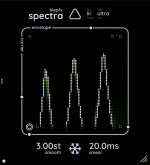
Spectra can split both its main and sidechain inputs into spectral envelope and harmonics, then blend those components independently. Source choice therefore changes far more than the flavor of the effect.
A vocal over a saw wave is the familiar starting point, but it hides the real rule. Envelope transfer needs usable energy in the carrier wherever the borrowed contour wants to shape it, while the envelope source needs enough spectral structure for Spectra to estimate something worth transferring.
This makes good source pairing for Spectra less about instrument labels and more about density, contrast, timing, and spectral coverage. Two impressive sounds can make a weak pair, while one plain source can give the other exactly the material it needs.
Broadband material usually gives envelope transfer more room to work. Noise, bright synth waves, distorted tones, cymbal-rich textures, and dense chords spread energy across many frequencies, so a borrowed contour can cut and emphasize without repeatedly running into space.
Sparse sources behave differently. A sine wave gives the processor almost nothing beyond one strong frequency, while a flute-like tone may contain only a modest set of prominent harmonics. If the transferred envelope asks for energy between those components, the carrier cannot invent a full harmonic bed from nothing.
Older cross-synthesis work ran into the same problem. LPC cross-synthesis experiments with musical excitation found that spectrally limited sources could become noisy when whitening boosted weak regions, while flatter excitation made a transferred speech spectrum more intelligible. Spectra gives you modern controls around the idea, but the underlying tradeoff has not disappeared.
More density is not automatically better. A bright, distorted carrier can make every formant and resonance jump forward, but it can also turn subtle envelope movement into a coarse wall of sound. Smooth, Whiten, and the carrier morph control become more important as the excitation gets busier.
Spectral density also changes intelligibility. Vocoder work has shown that denser carrier spectra can preserve useful envelope cues better under some conditions because more spectral components are available to carry the modulation. Music is less constrained than speech recognition, but the practical lesson travels well. A carrier with more usable components gives the transferred contour more places to become audible.
Contrast can be more interesting than similarity. Pairing two sustained pads with comparable spectra may create a polished morph that barely announces itself. Put a vocal envelope over a metallic percussion bed or a bowed texture over a noisy synth and the separation between shape and excitation becomes much easier to hear.
Rhythmic alignment becomes especially noticeable with drums and chopped material. Matching attacks can produce a tight hybrid because both signals change at useful moments together. Offset them, and Spectra may still create an interesting texture, but the borrowed envelope can feel detached from the articulation underneath it.
Sustained envelope sources are easier when you want gradual color changes. Vowels, pads, bowed notes, filtered noise, and held brass provide enough time to hear how the spectral contour moves. Fast percussion is better when the goal is imprinting short bursts of brightness, body, or resonance onto something steadier.
The main input and sidechain also do not need permanent textbook roles. Spectra lets you morph the envelope between both inputs and separately morph their whitened carriers, so either source can contribute shape, excitation, or a mixture of both. Treat those controls as a balance between identities rather than a fixed modulator-carrier assignment.
Start with one source whose envelope is obvious and another whose spectrum is generous. Once the transfer reads clearly, replace one side with something stranger. Sparse carriers, mismatched rhythms, and narrow-band material stop looking like bad choices at that point because you can hear exactly which limitation is creating the texture.
A vocal over a saw wave is the familiar starting point, but it hides the real rule. Envelope transfer needs usable energy in the carrier wherever the borrowed contour wants to shape it, while the envelope source needs enough spectral structure for Spectra to estimate something worth transferring.
This makes good source pairing for Spectra less about instrument labels and more about density, contrast, timing, and spectral coverage. Two impressive sounds can make a weak pair, while one plain source can give the other exactly the material it needs.
Source pairing starts with spectral coverage
Spectra describes the envelope as the rough spectral outline and the harmonics as the finer, spectrally flat detail. Its carrier stage works with whitened versions of the inputs, which reduces their original broad spectral shapes before a new envelope is imposed. Whiten exists partly because this flattening can otherwise pull weak frequency regions and noise upward too aggressively.Broadband material usually gives envelope transfer more room to work. Noise, bright synth waves, distorted tones, cymbal-rich textures, and dense chords spread energy across many frequencies, so a borrowed contour can cut and emphasize without repeatedly running into space.
Sparse sources behave differently. A sine wave gives the processor almost nothing beyond one strong frequency, while a flute-like tone may contain only a modest set of prominent harmonics. If the transferred envelope asks for energy between those components, the carrier cannot invent a full harmonic bed from nothing.
Older cross-synthesis work ran into the same problem. LPC cross-synthesis experiments with musical excitation found that spectrally limited sources could become noisy when whitening boosted weak regions, while flatter excitation made a transferred speech spectrum more intelligible. Spectra gives you modern controls around the idea, but the underlying tradeoff has not disappeared.
Sparse carriers expose holes fast
A useful test is to hold the envelope source constant and replace only the material feeding the carrier side of the blend. Start with a vocal or resonant synth phrase, then audition a sine, triangle, saw, noise source, and a harmonically rich patch at similar levels. The character of the borrowed envelope will become progressively easier to hear as usable spectral coverage increases.More density is not automatically better. A bright, distorted carrier can make every formant and resonance jump forward, but it can also turn subtle envelope movement into a coarse wall of sound. Smooth, Whiten, and the carrier morph control become more important as the excitation gets busier.
Spectral density also changes intelligibility. Vocoder work has shown that denser carrier spectra can preserve useful envelope cues better under some conditions because more spectral components are available to carry the modulation. Music is less constrained than speech recognition, but the practical lesson travels well. A carrier with more usable components gives the transferred contour more places to become audible.
Contrast can be more interesting than similarity. Pairing two sustained pads with comparable spectra may create a polished morph that barely announces itself. Put a vocal envelope over a metallic percussion bed or a bowed texture over a noisy synth and the separation between shape and excitation becomes much easier to hear.
Timing matters as much as timbre
Two sources can have excellent spectral compatibility and still produce a mushy result when their events fight each other. A plosive consonant arriving between the carrier's attacks has little strong material to grab at that instant. A sustained carrier gives the same envelope movement a continuous surface, which often makes speech-like changes easier to follow.Rhythmic alignment becomes especially noticeable with drums and chopped material. Matching attacks can produce a tight hybrid because both signals change at useful moments together. Offset them, and Spectra may still create an interesting texture, but the borrowed envelope can feel detached from the articulation underneath it.
Sustained envelope sources are easier when you want gradual color changes. Vowels, pads, bowed notes, filtered noise, and held brass provide enough time to hear how the spectral contour moves. Fast percussion is better when the goal is imprinting short bursts of brightness, body, or resonance onto something steadier.
The main input and sidechain also do not need permanent textbook roles. Spectra lets you morph the envelope between both inputs and separately morph their whitened carriers, so either source can contribute shape, excitation, or a mixture of both. Treat those controls as a balance between identities rather than a fixed modulator-carrier assignment.
Start with one source whose envelope is obvious and another whose spectrum is generous. Once the transfer reads clearly, replace one side with something stranger. Sparse carriers, mismatched rhythms, and narrow-band material stop looking like bad choices at that point because you can hear exactly which limitation is creating the texture.