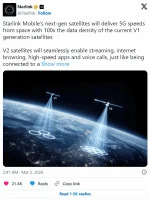
A claimed 100x data-density jump from Starlink's V2 satellites could transform satellite-to-phone service from emergency fallback into everyday connectivity.
What V2 satellites bring to the table
What V2 satellites bring to the table
- Starlink says V2 hardware delivers around 20x more throughput per satellite.
- Data density at the constellation level allegedly jumps 100x over V1 gear.
- That metric reflects how many users get served in a given area under load.
- SpaceX is branding the upgrade direction as 5G from space.
- Previously called Direct to Cell, the service targets standard phones with no tower access.
- Messaging, voice, and light data are the realistic V1 expectations.
- Existing LTE phones already work with the current satellite setup.
- T-Mobile is the flagship U.S. terrestrial partner for seamless handoffs.
- Smooth transitions between tower and satellite coverage are the stated goal.
- Getting that handover right makes satellite feel like a network extension, not a separate mode.
- No firm public date exists for broad V2-powered service availability.
- V2 Mini satellites are already going up to bridge the capability gap.
- Constellation density is the real bottleneck gating the rollout.
- Early 2027 looks plausible for initial testing or early-stage deployment.