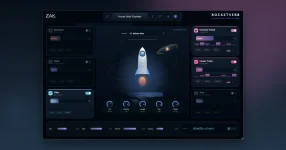
RocketVerb turns space audio into an actual reverb engine, synthesizing fresh tails in real time from planetary recordings and astronomical data. ZAK Sound dug through source material for spectral movement, density, damping, and texture, then baked those traits into 38 internal profiles steering the algorithm. Nothing gets replayed as samples or fixed impulses; every incoming sound spawns a brand-new tail.
Founder Ben D'urso framed the whole thing around one question: what if the behavior of space audio became part of the reverb itself?
An interactive Galaxy cursor hands you macro control over spatial movement. Six extra blocks named Radiation, Orbit, Filter, Granular Cloud, Comet Trails, and Dust pile on modulation, delays, filtering, granular processing, and texture. You get 144 factory presets spread across eight categories, alongside five main controls covering Pre, Density, Length, Size, and Shape.
Mac users get Audio Unit, VST3, AAX, and Standalone on Apple Silicon or Intel. Windows and Linux run VST3 and Standalone. Claim it free between July 22 and August 22, and that license stays perpetual, with no trial or subscription attached. After that window closes, it jumps to 39 dollars or 37 euros.
Founder Ben D'urso framed the whole thing around one question: what if the behavior of space audio became part of the reverb itself?
An interactive Galaxy cursor hands you macro control over spatial movement. Six extra blocks named Radiation, Orbit, Filter, Granular Cloud, Comet Trails, and Dust pile on modulation, delays, filtering, granular processing, and texture. You get 144 factory presets spread across eight categories, alongside five main controls covering Pre, Density, Length, Size, and Shape.
Mac users get Audio Unit, VST3, AAX, and Standalone on Apple Silicon or Intel. Windows and Linux run VST3 and Standalone. Claim it free between July 22 and August 22, and that license stays perpetual, with no trial or subscription attached. After that window closes, it jumps to 39 dollars or 37 euros.