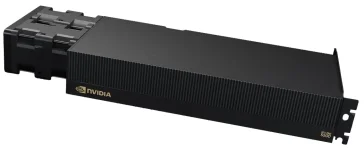
The RTX PRO 5500 can draw up to 600 W through a single PCIe CEM5 16-pin connector in its air-cooled workstation form. PNY lists the board at 4.4 inches high and 11.1 inches long, with a full-height, full-length dual-slot layout.
Those numbers rule out the casual upgrade mentality. A motherboard may have a physical x16 slot and still live inside a chassis with the wrong power delivery, cramped cable clearance, weak exhaust, or too little system memory. A serious fit check has to cover the whole machine.
The 600 W RTX PRO 5500 workstation card is also aimed at rack-mounted deployments, where component spacing gets less forgiving. Dense systems can move plenty of air, but only when the chassis was built around a known thermal path instead of treating the GPU as an oversized desktop add-in.
PNY specifies one PCIe CEM5 16-pin connector on the card. Cable routing matters because the connector sits inside a system that already has an 11.1-inch board occupying two slots, and tight bends near high-power connectors are poor design practice. The case needs enough room for the plug and cable path, not merely enough length for the PCB.
Power supply quality matters as much as the number printed on its label. A rack workstation running sustained AI inference or rendering may hold the GPU near heavy load for hours instead of producing short gaming bursts. Proper headroom has to be calculated from the complete system configuration and the PSU manufacturer's continuous-load guidance.
Multiple cards make the arithmetic harsher. Two RTX PRO 5500 boards can represent up to 1,200 W of GPU load before the CPUs and everything else wake up. At that point, motherboard slot spacing, auxiliary power distribution, circuit capacity, chassis airflow, and the workstation vendor's validated GPU list become part of the purchase decision.
Rack depth and fan pressure matter here. Desktop cases often give a GPU open space and large side volumes, while rack systems force air through narrower paths crowded with CPUs, memory, drive cages, risers, and cabling. A nominal dual-slot fit says nothing about whether the fans can breathe under sustained load.
High-density systems increasingly use direct-to-chip liquid cooling for concentrated heat loads because moving several hundred watts from tightly packed components becomes a system-level thermal problem. The RTX PRO 5500's liquid-cooled option fits that environment, but it should not be read as evidence that every 600 W installation requires liquid cooling.
The quieter failure mode is recirculation. Hot exhaust from one accelerator can raise the inlet temperature of the next device, leaving the chassis technically within its slot count while sustained performance suffers. Rack builders should care about inlet temperature, fan curves, baffles, blanking, and component placement rather than relying on the GPU's cooler alone.
Those capacities do not map neatly onto every workstation memory layout. A machine with 64 GB may have a perfectly suitable CPU, PSU, and PCIe slot yet still fall below PNY's stated host-memory floor. Reaching 168 GB can also affect DIMM population, memory-channel balance, platform choice, and upgrade cost.
PNY calls a PCIe 5.0 x16 expansion slot preferred, while NVIDIA lists PCIe Gen 5 x16 as the graphics bus. You should still check the workstation maker's compatibility matrix rather than assuming that any physically compatible x16 slot provides the intended configuration. Riser design, lane allocation, neighboring cards, and BIOS support can all complicate a rack build.
Display requirements can be simpler in remote or compute-heavy deployments, but physical access still matters for installation and service. An 11.1-inch full-length board with a high-power cable needs room to remove, reseat, and replace without dismantling half the system. In a dense rack, service clearance becomes part of compatibility just as surely as electrical fit.
Those numbers rule out the casual upgrade mentality. A motherboard may have a physical x16 slot and still live inside a chassis with the wrong power delivery, cramped cable clearance, weak exhaust, or too little system memory. A serious fit check has to cover the whole machine.
The 600 W RTX PRO 5500 workstation card is also aimed at rack-mounted deployments, where component spacing gets less forgiving. Dense systems can move plenty of air, but only when the chassis was built around a known thermal path instead of treating the GPU as an oversized desktop add-in.
The power connector is only half the electrical problem
A 600 W board rating does not tell you what power supply to buy. The CPU, memory, storage, fans, pumps, network cards, and transient load behavior all sit on top of the GPU demand. NVIDIA has not published a universal whole-system PSU figure for every possible RTX PRO 5500 workstation configuration, so a single wattage recommendation would be guesswork.PNY specifies one PCIe CEM5 16-pin connector on the card. Cable routing matters because the connector sits inside a system that already has an 11.1-inch board occupying two slots, and tight bends near high-power connectors are poor design practice. The case needs enough room for the plug and cable path, not merely enough length for the PCB.
Power supply quality matters as much as the number printed on its label. A rack workstation running sustained AI inference or rendering may hold the GPU near heavy load for hours instead of producing short gaming bursts. Proper headroom has to be calculated from the complete system configuration and the PSU manufacturer's continuous-load guidance.
Multiple cards make the arithmetic harsher. Two RTX PRO 5500 boards can represent up to 1,200 W of GPU load before the CPUs and everything else wake up. At that point, motherboard slot spacing, auxiliary power distribution, circuit capacity, chassis airflow, and the workstation vendor's validated GPU list become part of the purchase decision.
Cooling depends on the chassis rather than the slot count
NVIDIA lists active air cooling for the standard workstation card and says a liquid-cooled RXM solution is available. Air cooling can work perfectly well, but a 600 W heat source needs a chassis capable of supplying cool air and removing the exhaust without feeding it straight into another hot component.Rack depth and fan pressure matter here. Desktop cases often give a GPU open space and large side volumes, while rack systems force air through narrower paths crowded with CPUs, memory, drive cages, risers, and cabling. A nominal dual-slot fit says nothing about whether the fans can breathe under sustained load.
High-density systems increasingly use direct-to-chip liquid cooling for concentrated heat loads because moving several hundred watts from tightly packed components becomes a system-level thermal problem. The RTX PRO 5500's liquid-cooled option fits that environment, but it should not be read as evidence that every 600 W installation requires liquid cooling.
The quieter failure mode is recirculation. Hot exhaust from one accelerator can raise the inlet temperature of the next device, leaving the chassis technically within its slot count while sustained performance suffers. Rack builders should care about inlet temperature, fan curves, baffles, blanking, and component placement rather than relying on the GPU's cooler alone.
System memory can become the overlooked compatibility limit
PNY's system requirements contain a detail that launch stories tend to skip. System memory should be at least as large as the GPU memory, with twice the GPU memory recommended. For an 84 GB RTX PRO 5500, the stated guidance therefore means at least 84 GB of system RAM and 168 GB recommended.Those capacities do not map neatly onto every workstation memory layout. A machine with 64 GB may have a perfectly suitable CPU, PSU, and PCIe slot yet still fall below PNY's stated host-memory floor. Reaching 168 GB can also affect DIMM population, memory-channel balance, platform choice, and upgrade cost.
PNY calls a PCIe 5.0 x16 expansion slot preferred, while NVIDIA lists PCIe Gen 5 x16 as the graphics bus. You should still check the workstation maker's compatibility matrix rather than assuming that any physically compatible x16 slot provides the intended configuration. Riser design, lane allocation, neighboring cards, and BIOS support can all complicate a rack build.
Display requirements can be simpler in remote or compute-heavy deployments, but physical access still matters for installation and service. An 11.1-inch full-length board with a high-power cable needs room to remove, reseat, and replace without dismantling half the system. In a dense rack, service clearance becomes part of compatibility just as surely as electrical fit.