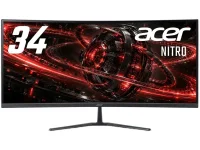
Acer Nitro has two new 34-inch gaming screens in Japan, and both can trade sharp detail for speed. The curved VA panels use DFR tech to switch between 5K and WFHD modes, giving gamers a choice based on what they play.
The pricier ED340CKRPbmiipx can hit 180 Hz at 5,120 × 2,160, or jump to 360 Hz at 2,560 × 1,080. Acer claims a 1 ms gray-to-gray response, with a best-case figure of 0.5 ms. Its contrast ratio sits at 3,300:1 on paper.
Meanwhile, the ED340CKRJbmiipx takes a less extreme route. It runs 5K at 120 Hz or WFHD at 240 Hz, with a stated contrast of 3,000:1. That gives buyers the same basic screen modes, just with lower refresh caps.
Both models have a 1500R curve and a wide 21:9 shape. AMD FreeSync Premium handles screen sync, while Acer rates color coverage at 90% of DCI-P3. Brightness tops out at a claimed 250 cd/m², and viewing angles reach 178 degrees.
The port setup is quite basic. Each screen gets two HDMI 2.1 inputs, one DisplayPort 1.4 socket, and a pair of 2 W speakers. Users can tilt the stand from -5 to 20 degrees, but Acer does not list other stand moves.
Here's the neat part. A single monitor can favor crisp visuals for work or detailed games, then switch to a fast mode for ranked play. But 360 Hz only works at the lower pixel count. It does not mean the panel can run full 5K at that speed.
Price may be the next big factor. Japan's listed rates work out to about $627 for the faster model and $438 for its sibling. Those are rough dollar values based on a yen exchange rate of ¥159.45 per dollar, not official U.S. retail tags.
Some real tests would help clear things up. Acer has not shown how smooth the DFR switch is, or how well FreeSync behaves in each mode. Measured brightness, pixel speed, and contrast could also differ from the spec sheet.
For gamers who split their time between sharp visuals and high frame rates, this setup could be handy. Still, there is no firm word on sales beyond Japan, and the final verdict will depend on how well the panels perform outside Acer's lab.