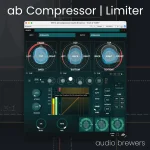
IEM’s OmniCompressor uses the Ambisonic W channel as its detector and applies one calculated gain across the entire encoded soundfield. It is a simple choice with a serious purpose because every spherical-harmonic component keeps moving up and down together through the entire gain cycle.
Ambisonics is not a bundle of speaker feeds waiting for separate faders inside the encoded domain. Its channels describe components of a soundfield, and their level relationships help determine what a decoder later reconstructs around you. Compress those components independently and the decoded position, width, or focus can change while the compressor works, even when the output meter looks sensible.
Stereo habits make this mistake surprisingly easy because two linked channels already teach us to worry about image shift. Higher-order Ambisonics carries many more interdependent components, so per-channel compression can turn routine gain reduction into spatial movement during loud passages.
IEM uses this approach in its broadband OmniCompressor, and its multiband design repeats the logic inside each frequency band. You still hear compression because attack, release, ratio, and threshold reshape level over time rather than space. What you avoid is a different envelope being invented for every spherical-harmonic channel.
The distinction matters most when gain reduction gets busy. A fast detector reacting separately to dozens of channels can produce dozens of slightly different recovery curves, even when one acoustic event created them. Decoding those moving relationships can make a source smear, narrow, widen, or pull away from its original direction as the envelope recovers.
Limiting deserves the same caution because independent channel limiters may catch different peaks at different moments. Their gain histories can diverge quickly, while an Ambisonic limiter built around linked or spatially aware control avoids turning peak management into moving spatial balance.
Newer processors push the idea further, and spatial dynamics controls across dimensional poles let front, back, left, right, top, and bottom react differently. Used deliberately, this can tame a hard front-facing transient without flattening quieter ambience behind the listener. Used carelessly, it can make the scene lean away from whatever becomes loudest as gain reduction deepens.
A useful distinction appears here because coherent compression tries to change dynamics while leaving spatial relationships alone. Directional compression intentionally changes dynamics according to position, so it solves a different problem and needs a different listening test in motion.
In a dense immersive bed, front percussion can trigger whole-field compression that drags down long environmental tails behind the listener. Directional control can spare those tails, but hard settings may make the front-to-back balance pump with the groove instead of simply controlling peaks.
A development report for IEM’s Ambisonic multiband compressor found real-time phase compensation expensive. Its 512-tap compensation stage raised measured CPU use from about 3 percent to 8.1 percent, and moving crossovers produced audible glitches in the tested implementation.
None of this makes multiband processing a bad idea. A spatially safe compressor has two jobs at once, keeping gain relationships sensible while preventing the band-splitting stage from creating its own damage. Higher-order sessions increase the cost because the same filter work repeats across many channels before the signal ever reaches a decoder.
Check the result through the decoder you will actually use, then move your head or rotate the scene while gain reduction is active. Level-match the bypass so loudness does not win the comparison. A source that stays put when idle but drifts, blurs, or changes width during compression is showing a spatial envelope problem, not merely a tonal preference.
Ambisonics is not a bundle of speaker feeds waiting for separate faders inside the encoded domain. Its channels describe components of a soundfield, and their level relationships help determine what a decoder later reconstructs around you. Compress those components independently and the decoded position, width, or focus can change while the compressor works, even when the output meter looks sensible.
Stereo habits make this mistake surprisingly easy because two linked channels already teach us to worry about image shift. Higher-order Ambisonics carries many more interdependent components, so per-channel compression can turn routine gain reduction into spatial movement during loud passages.
Linked gain keeps the Ambisonic image stable
One established solution is spatially coherent gain reduction, where the omnidirectional W component drives a single compressor envelope instead of each higher-order component. Apply the resulting gain equally to every Ambisonic component, and relative channel levels survive because every component moves together sample by sample.IEM uses this approach in its broadband OmniCompressor, and its multiband design repeats the logic inside each frequency band. You still hear compression because attack, release, ratio, and threshold reshape level over time rather than space. What you avoid is a different envelope being invented for every spherical-harmonic channel.
The distinction matters most when gain reduction gets busy. A fast detector reacting separately to dozens of channels can produce dozens of slightly different recovery curves, even when one acoustic event created them. Decoding those moving relationships can make a source smear, narrow, widen, or pull away from its original direction as the envelope recovers.
Limiting deserves the same caution because independent channel limiters may catch different peaks at different moments. Their gain histories can diverge quickly, while an Ambisonic limiter built around linked or spatially aware control avoids turning peak management into moving spatial balance.
Directional compression makes space part of the envelope
Preserving the whole field is not always the creative goal. IEM’s DirectionalCompressor can derive control from a full, masked, or unmasked region and can apply compression to those regions selectively. The processor works with a spatial mask rather than pretending the encoded components are ordinary output channels with independent destinations.Newer processors push the idea further, and spatial dynamics controls across dimensional poles let front, back, left, right, top, and bottom react differently. Used deliberately, this can tame a hard front-facing transient without flattening quieter ambience behind the listener. Used carelessly, it can make the scene lean away from whatever becomes loudest as gain reduction deepens.
A useful distinction appears here because coherent compression tries to change dynamics while leaving spatial relationships alone. Directional compression intentionally changes dynamics according to position, so it solves a different problem and needs a different listening test in motion.
In a dense immersive bed, front percussion can trigger whole-field compression that drags down long environmental tails behind the listener. Directional control can spare those tails, but hard settings may make the front-to-back balance pump with the groove instead of simply controlling peaks.
Multiband control adds a second spatial failure mode
Multiband compression for Ambisonics adds crossovers before the gain stages, which brings phase behavior into the picture. A four-band processor can keep compression confined to the frequency range causing trouble, yet the filter bank still has to split and recombine a multichannel soundfield cleanly. Crossover design is no longer a boring implementation detail when dozens of encoded channels pass through it.A development report for IEM’s Ambisonic multiband compressor found real-time phase compensation expensive. Its 512-tap compensation stage raised measured CPU use from about 3 percent to 8.1 percent, and moving crossovers produced audible glitches in the tested implementation.
None of this makes multiband processing a bad idea. A spatially safe compressor has two jobs at once, keeping gain relationships sensible while preventing the band-splitting stage from creating its own damage. Higher-order sessions increase the cost because the same filter work repeats across many channels before the signal ever reaches a decoder.
Check the result through the decoder you will actually use, then move your head or rotate the scene while gain reduction is active. Level-match the bypass so loudness does not win the comparison. A source that stays put when idle but drifts, blurs, or changes width during compression is showing a spatial envelope problem, not merely a tonal preference.