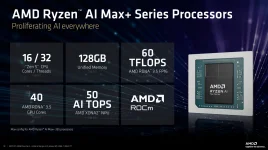
AMD has just released a couple more chips to complete its lineup. They added two new Strix Halo APUs called the Ryzen AI Max Plus 388 and 392. These essentially slot in between the existing models by enhancing the integrated graphics while leaving the CPU part largely unchanged. Both chips keep the same core counts as their non-Plus versions. The 388 has eight cores and sixteen threads, matching the regular 385. The 392 has twelve cores and twenty-four threads, just like the 390. Their max boost speeds also stay the same, hitting up to five gigahertz.
The real upgrade is in the graphics. AMD gave these Plus models forty compute units for the iGPU, up from thirty-two in the standard versions. That bumps the theoretical graphics performance from forty-eight teraflops to sixty teraflops. This puts their graphics power much closer to the top-tier chip, the Ryzen AI Max Plus 395. For laptops without a separate graphics card, this should mean a noticeable jump in gaming and rendering.
Their AI performance is not any different. All the chips in this family, including the new ones, have the same neural processing unit rated at fifty trillion operations per second. The flagship 395 still leads the pack with sixteen cores, but these new options give more choices just below it. By introducing these models, AMD is letting computer makers fine-tune their designs with better graphics without having to change the processor or AI specs.
The real upgrade is in the graphics. AMD gave these Plus models forty compute units for the iGPU, up from thirty-two in the standard versions. That bumps the theoretical graphics performance from forty-eight teraflops to sixty teraflops. This puts their graphics power much closer to the top-tier chip, the Ryzen AI Max Plus 395. For laptops without a separate graphics card, this should mean a noticeable jump in gaming and rendering.
Their AI performance is not any different. All the chips in this family, including the new ones, have the same neural processing unit rated at fifty trillion operations per second. The flagship 395 still leads the pack with sixteen cores, but these new options give more choices just below it. By introducing these models, AMD is letting computer makers fine-tune their designs with better graphics without having to change the processor or AI specs.