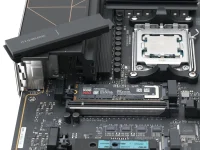
That chunky Gen5 heatsink bolted to the motherboard might be touching almost nothing, and twenty current AMD and Intel boards got tested to check. A 3.8mm Crucial T705 2TB went into each primary Gen5 slot, and the squish marks in the thermal pads told the story.
Six boards nailed it. Five landed in the maybe pile, technically full but faint, while nine came back ugly, a few kissing only the controller or one NAND cluster.
Brand loyalty buys nothing, since results scattered inside every lineup. MSI went two for six, Gigabyte one for three, ASRock four for seven, and three of four ASUS boards made full contact, just barely.
Blame the spec, which caps component height rather than pinning every drive to one thickness. Controllers, NAND, and DRAM sit at different elevations, and one pad cannot chase all of it.
Heat is not theoretical. An uncooled Transcend 260S sank from around 4,000MB/s to roughly 1,700MB/s once fifty seconds ticked by, which is why eyeballing pad squish and drive temps after a build pays off.
Six boards nailed it. Five landed in the maybe pile, technically full but faint, while nine came back ugly, a few kissing only the controller or one NAND cluster.
Brand loyalty buys nothing, since results scattered inside every lineup. MSI went two for six, Gigabyte one for three, ASRock four for seven, and three of four ASUS boards made full contact, just barely.
Blame the spec, which caps component height rather than pinning every drive to one thickness. Controllers, NAND, and DRAM sit at different elevations, and one pad cannot chase all of it.
Heat is not theoretical. An uncooled Transcend 260S sank from around 4,000MB/s to roughly 1,700MB/s once fifty seconds ticked by, which is why eyeballing pad squish and drive temps after a build pays off.