AMD is already victory-lapping Intel’s unreleased chips, basically saying Panther Lake is about to walk into a buzzsaw.
AMD sets the board before launch
AMD sets the board before launch
- AMD rolled out its own scorecard before Intel even hit shelves.
- The comparison targets Intel’s upcoming Core Ultra Series 3 Panther Lake lineup.
- These are AMD’s internal expectations, not third-party benchmarks.
- AMD split its notebook lineup into four tiers.
- Premium sits at the top, mainstream and thin-light in the middle.
- Entry-level is where volume fights get ugly.
- Ryzen AI MAX is AMD’s top dog.
- Two fresh chips just landed, Ryzen AI MAX+ 392 and Ryzen AI MAX+ 388.
- AMD says these lock in its graphics edge inside a single SoC.
- Devices like the ASUS TUF A14 are already being waved around as proof.
- The comparison target is Intel’s Panther Lake X SKUs.
- Those chips lean on Arc B390 or Arc B370 graphics.
- AMD claims wins across content creation, gaming, and AI.
- AI performance is framed as CPU plus NPU plus GPU, not just one block.
- AMD says the current Ryzen AI MAX lineup is enough.
- No urgent need for a Strix Halo follow-up.
- The message is simple: existing silicon already handles the fight.
- Ryzen AI 400 goes head-to-head with Core Ultra 9 and Core Ultra 7 Panther Lake.
- Ryzen AI 300 lines up against lower Core Ultra 7 and Core Ultra 5 parts.
- This is where most laptops actually sell.
- Intel’s mainstream chips mostly ship with 4 Xe3 graphics.
- That is about a third of the full Xe3 setup.
- AMD keeps Radeon 890M and 880M iGPUs with 16 to 12 compute units.
- Higher clocks mean AMD expects stronger gaming and creation results again.
- Intel’s Wildcat Lake SKUs anchor the low end.
- These come with 2 Xe3 cores and 6 CPU cores.
- AMD counters with Ryzen AI 300 and Ryzen 200.
- AMD claims wins in content creation, gaming, and AI here as well.
- Pricing and efficiency are the real weapons in this tier.
- AMD directly pushed back on Intel’s CES 2026 messaging.
- The focus stayed on graphics, productivity, and efficiency claims.
- Intel said the Core Ultra X9 388H sits in its own graphics tier.
- AMD fired back, saying Ryzen AI MAX 395+ delivers 37 percent faster graphics.
- AMD admits Intel jumped far past Lunar Lake, but still says Strix Halo stays ahead.
- Intel talked up performance scaling and productivity.
- AMD countered by pointing at the thread count.
- Panther Lake tops out at 16 cores without hyperthreading.
- Strix Halo packs 16 Zen 5 cores with 32 threads.
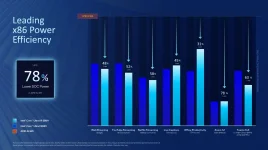
- Intel claimed leading x86 power efficiency.
- AMD says Intel’s own data barely shows gains over Lunar Lake.
- Some slides even show similar or higher SoC power.
- One comparison still shows Panther Lake drawing less power than Ryzen AI 9 365.
- Real-world testing is still the decider.
- AMD pointed out that Intel barely talked about non-flagship SKUs.
- No big claims on performance, graphics, or AI outside the top tier.
- AMD expects Ryzen AI 400 to dominate those gaps.
- These are all pre-launch claims.
- Reviews land in days, not months.
- Panther Lake looked solid on the show floors.
- Ryzen AI MAX is still the benchmark for high-performance Halo SoCs.
- Ryzen AI 400 is positioned as the volume play.
- AMD is confident, maybe aggressively so.
- Intel is promising big numbers but staying selective.
- Actual benchmarks are about to settle the noise.
- Either way, the laptop CPU fight is officially heated again.