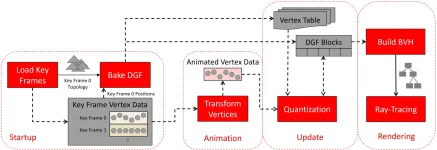
AMD plans to enhance graphics card performance through Dense Geometry Format technology that compresses animation data and improves ray tracing efficiency. The company outlined this approach in a technical blog post on GPUOpen, explaining how DGF divides large triangle meshes into smaller blocks that require less memory bandwidth during processing.
Current AMD graphics cards handle DGF through compute shader units, but future UDNA architecture could shift this work to dedicated hardware accelerators. The compressed format allows graphics processors to build ray tracing acceleration structures directly from DGF blocks, reducing the computational overhead of rebuilding bounding volume hierarchies. This method enables more geometry data to fit within GPU cache memory, decreasing latency during rendering operations.
The technology uses per-frame compute shaders and re-quantization to update compressed blocks without unpacking entire datasets. AMD expects these improvements will deliver faster animation performance on upcoming graphics cards while consuming fewer system resources during complex rendering tasks.
Current AMD graphics cards handle DGF through compute shader units, but future UDNA architecture could shift this work to dedicated hardware accelerators. The compressed format allows graphics processors to build ray tracing acceleration structures directly from DGF blocks, reducing the computational overhead of rebuilding bounding volume hierarchies. This method enables more geometry data to fit within GPU cache memory, decreasing latency during rendering operations.
The technology uses per-frame compute shaders and re-quantization to update compressed blocks without unpacking entire datasets. AMD expects these improvements will deliver faster animation performance on upcoming graphics cards while consuming fewer system resources during complex rendering tasks.