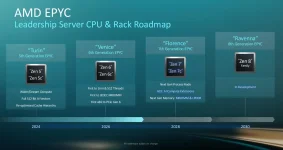
AMD has put Zen 6 into commercial servers, with claims of its biggest CPU performance leap since the first Zen chips. The new EPYC 9006 family reaches 256 cores, while a revamped chip design aims to get more work done per clock. Independent tests still need to prove those gains.
The architecture has two types of cores. Regular Zen 6 targets faster speeds above 5GHz, using around 5W to 10W per core. Compact Zen 6c trades some speed for lower power use, with a stated 4.1GHz ceiling and a range of roughly 1.2W to 3.5W.
Performance claims are fairly bold. AMD cites an average IPC gain of about 27% over Zen 5, with separate figures of 20% for cloud and business tasks and 31% for AI. Different tests and core types affect those numbers, though, and consumer chips may not match the server results.
Underneath, the CPU gets more room to handle instructions. Its micro-op cache rises from 6,000 to 6,750 entries, while throughput climbs from 12 to 18 operations each cycle. A larger return stack, better branch prediction, and expanded scheduling resources aim to keep the execution units busy.
AI and math tasks get new instruction support as well. AVX-VNNI-INT8, AVX-NE-Convert, AVX-IFMA, and Bit Matrix Multiply join the feature set. Direct FP16 calculations also cut out the need to convert values to 32-bit precision first, as Zen 5 did.
Core density takes a notable jump. A standard compute chiplet can fit 12 cores instead of eight, which leaves room for a possible 24-core dual-chiplet Ryzen 9. AMD has not confirmed such a desktop model. Dense Zen 6c chiplets can fit 32 active cores, twice the prior count.
Cache gets an upgrade for compact cores. Each Zen 6c core can use 4MB of L3, twice its prior share, giving a full chiplet 128MB. Standard L1 and L2 sizes stay the same. AMD also uses TSMC's 2nm-class process for the new designs.
Chiplet links are changing as well. Elevated fanout bridge packaging, or EFB, uses silicon connections in part of the package. AMD says this can cut delay and power use while raising bandwidth between components. That's another gain that needs real-world testing.
Server buyers get the first products through EPYC 9006 Venice. The SP7 platform offers 16 DDR5 memory channels, up to 1.6TB/s of bandwidth, and 96 PCIe 6.0 lanes. Memory speeds can reach 8,000 MT/s with DDR5 or 12,800 MT/s through MRDIMM. Power ratings can reach 600W.
At the top, EPYC 9996 has 256 cores, 512 threads, 1,024MB of L3, and a $14,904 list price. The 96-core EPYC 9686F targets jobs that favor speed, with a listed 5.0GHz boost and $11,434 price. AMD's briefing also cites a 5.3GHz peak for the model.
Other SP7 choices span dense and faster core layouts, while SP8 expands the range for different server needs. Prices across the stated lineup run from $700 for the eight-core EPYC 9016 to nearly $15,000. Power ratings, cache sizes, and clock speeds vary quite a bit.
A separate Venice-X design targets tasks that benefit from extra cache. Its planned flagship combines 96 Zen 6 cores with 1,152MB of L3. Each of eight chiplets has 48MB of regular cache and another 96MB stacked beneath the compute die.
That layout helps keep heat from the cache stack away from the cores. AMD also reports a peak speed of 5.3GHz for Venice-X, compared with 3.7GHz for Genoa-X. Simulation, chip design, and fluid dynamics are among the tasks it aims to serve. Pricing and final power details remain open.
Verano is a different project aimed at AI host systems. It is meant to work with future Instinct GPUs and LPDDR5X SOCAMM2 memory, rather than serve as another cache-heavy Venice model.
Major server makers have begun shipping SP7 systems, with Microsoft Azure and Oracle Cloud Infrastructure expected to add cloud options. AMD also says Helios rack systems use the new processors. Actual access depends on the vendor, region, and hardware setup.
Desktop buyers still have no official Zen 6 lineup to pick from. For data centers, the bigger question is how much the new cores, cache, and faster I/O help with real tasks. AMD has set high expectations, but its internal figures aren't a substitute for independent benchmarks.