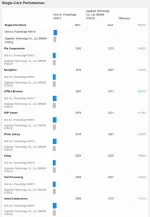
AMD EPYC 9996 reportedly scored 2,847 in a leaked Geekbench 7.1 single-core test. The early Zen 6c chip has 256 cores and 512 threads, yet its result comes from just one thread. AMD has not backed the leak, and no independent review has checked the claim.
For context, a Ryzen 7 9700X got 2,444 points with its clock locked at 4.1 GHz. The Zen 5 chip has eight cores and 16 threads. With the EPYC sample near the same speed, the gap works out to 16.5% in favor of Zen 6c.
That is a neat result for a chip made to pack lots of cores into a server. It hints that each core may get more work done per clock in some tasks. But one test cannot prove a broad gain in IPC.
The server setup had some serious specs. A Dell PowerEdge R9815 ran the EPYC sample on Linux, with Geekbench 7.1.0 and AVX2 in use. Its L3 cache was said to be 1 GB. The Ryzen test used CachyOS, DDR5-6000 CL34 RAM, and a fabric speed of 2,000 MHz.
Not every test gave the same lead, either. The gains ranged from 8.2% to 25.7%. HTML5 Browser, Photo Editor, Structure from Motion, and Video Player showed some of the wider gaps. Clang and File Compression had much tighter results.
That matters quite a bit. Geekbench gives each task a role in the total score, and the mix can change how large a lead appears. A gain in one type of work does not mean every app will run that much faster.
Another data point comes from the EPYC 4545P. That Zen 5 server chip hit 3,064 points while running near 5.45 GHz. It had a higher raw score, but its clock was much faster. Dividing each score by its clock rate makes the Zen 6c result look strong.
Still, that math has limits. The chips ran on different systems, with their own cache layouts, memory traits, and boost behavior. Even when clock speeds match on paper, the platforms can affect the results. This is not a direct IPC test.
There is another catch for desktop fans. Zen 6c uses a dense core layout aimed at servers with high core counts. It is not the standard Zen 6 design expected in future Ryzen desktop chips.
As for gaming, the leak proves very little. It gives no firm answer on retail clock speeds, power use, prices, or how fast a new Ryzen CPU might run. The sample may even have early firmware and RAM settings that change before release.
AMD has yet to share final consumer Zen 6 specs. For a fair check of the claimed gains, testers will need retail chips, similar test platforms, and a far wider set of apps.