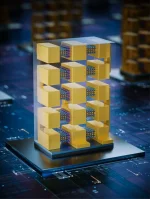
Beijing University scientists have made the first two-dimensional gate-all-around field-effect transistor anywhere on Earth. Their breakthrough raises the bar for Chinese computer chip design. Nature magazine published their findings about this different transistor approach that might transform how China builds microchips. Testing shows these run 40% faster and need 10% less power than the best TSMC 3 nm N3 chips.
Professors Peng Hailin and Qiu Chenguang led the research group. They built a multi-layered 2D system that outperforms current market leaders. The team picked bismuth oxyselenide instead of silicon as their material. This substance carries electrical signals extremely well at tiny sizes. That matters because companies find it harder and harder to shrink silicon chips further.
Professor Peng points out that silicon transistors face basic physical barriers when shrunk extremely small. He believes their transistor design beats all others for both speed and power use. Their 2D GAAFET fixes the main problem where silicon performs worse at ultra-small sizes, helping chip performance advance beyond what we see today. China focused on this research during its major effort to build independent semiconductor capacity after trade barriers limited its access to advanced manufacturing equipment.
China has begun creating its domestic EUV technology but hasn't demonstrated reliable results yet. Instead of merely trying to catch up with existing manufacturing methods, these Beijing researchers developed a completely new technical path. Professor Peng considers their approach similar to switching to an entirely different road rather than making small gains in areas where Chinese tech currently lags behind global competitors.
Professors Peng Hailin and Qiu Chenguang led the research group. They built a multi-layered 2D system that outperforms current market leaders. The team picked bismuth oxyselenide instead of silicon as their material. This substance carries electrical signals extremely well at tiny sizes. That matters because companies find it harder and harder to shrink silicon chips further.
Professor Peng points out that silicon transistors face basic physical barriers when shrunk extremely small. He believes their transistor design beats all others for both speed and power use. Their 2D GAAFET fixes the main problem where silicon performs worse at ultra-small sizes, helping chip performance advance beyond what we see today. China focused on this research during its major effort to build independent semiconductor capacity after trade barriers limited its access to advanced manufacturing equipment.
China has begun creating its domestic EUV technology but hasn't demonstrated reliable results yet. Instead of merely trying to catch up with existing manufacturing methods, these Beijing researchers developed a completely new technical path. Professor Peng considers their approach similar to switching to an entirely different road rather than making small gains in areas where Chinese tech currently lags behind global competitors.