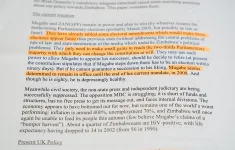
Old files show the UK really wanted Mugabe gone, but had zero good options. Declassified documents reveal Tony Blair's government grew deeply frustrated with Zimbabwean leader Robert Mugabe's refusal to step down amid escalating violence and economic collapse. Despite that pressure, the Foreign Office explicitly ruled out military force in a 2004 assessment, stating Britain would be completely isolated in any invasion attempt, predicting heavy casualties with no clear exit strategy. Officials noted that no African nation would support forcibly removing Mugabe short of a massive regional catastrophe.
With invasion off the table, officials debated other approaches. Then ambassador Brian Donnelly suggested Blair attempt direct engagement with Mugabe after the upcoming elections, drawing a parallel to the successful outreach with Libya's Muammar Gaddafi. Blair showed interest in this plan, instructing the Foreign Office to devise a full strategy combining exposure of Zanu-PF misconduct with potential re-engagement. However, diplomats in London were highly doubtful, viewing past engagement attempts as failures that would appear as a weak reversal. They also warned that additional sanctions would backfire, harming ordinary citizens while fueling Mugabe's narrative of British persecution. The consensus was that the eighty-year-old dictator, described as depressingly healthy and driven to secure his succession, would only leave under overwhelming pressure or by his own choice. The files conclude the only viable path was to wait him out, a strategy that ultimately meant Mugabe retained power for thirteen more years until his removal in 2017.
With invasion off the table, officials debated other approaches. Then ambassador Brian Donnelly suggested Blair attempt direct engagement with Mugabe after the upcoming elections, drawing a parallel to the successful outreach with Libya's Muammar Gaddafi. Blair showed interest in this plan, instructing the Foreign Office to devise a full strategy combining exposure of Zanu-PF misconduct with potential re-engagement. However, diplomats in London were highly doubtful, viewing past engagement attempts as failures that would appear as a weak reversal. They also warned that additional sanctions would backfire, harming ordinary citizens while fueling Mugabe's narrative of British persecution. The consensus was that the eighty-year-old dictator, described as depressingly healthy and driven to secure his succession, would only leave under overwhelming pressure or by his own choice. The files conclude the only viable path was to wait him out, a strategy that ultimately meant Mugabe retained power for thirteen more years until his removal in 2017.