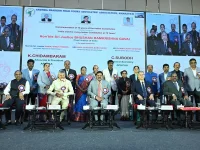
Chief Justice of India BR Gavai has reaffirmed his position that economically advantaged members of the Scheduled Castes should be excluded from reservation benefits through a creamy layer principle. Speaking at an Andhra Pradesh High Court Advocates Association event marking the 75th anniversary of the Indian Constitution, he argued that children of senior bureaucrats receiving elite education cannot be equated with the offspring of impoverished agricultural workers when determining reservation eligibility, despite both belonging to the Scheduled Castes.
The Chief Justice referenced a seven-judge bench decision on SC sub-classification, noting that six justices supported allowing states to create subcategories when certain SC groups remain underrepresented. He acknowledged widespread criticism of his stance on applying the creamy layer concept to Scheduled Castes, similar to its current use for Other Backward Classes, but maintained that true equality requires substantive rather than merely formal treatment.
Gavai credited the Constitution for enabling his rise from a municipal school in a semi-slum area of Amravati to the judiciary's highest position. He cited BR Ambedkar's vision of an evolving constitutional framework that balances accessibility for socio-economic amendments with stringent requirements for changes affecting fundamental structures.
The Chief Justice referenced a seven-judge bench decision on SC sub-classification, noting that six justices supported allowing states to create subcategories when certain SC groups remain underrepresented. He acknowledged widespread criticism of his stance on applying the creamy layer concept to Scheduled Castes, similar to its current use for Other Backward Classes, but maintained that true equality requires substantive rather than merely formal treatment.
Gavai credited the Constitution for enabling his rise from a municipal school in a semi-slum area of Amravati to the judiciary's highest position. He cited BR Ambedkar's vision of an evolving constitutional framework that balances accessibility for socio-economic amendments with stringent requirements for changes affecting fundamental structures.