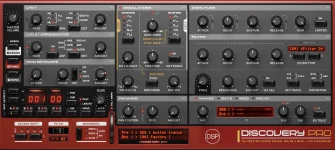
Discovery Pro 9.3 cuts filter-distortion processing at 8x and 16x playback quality to about one-tenth of its previous cost. The change comes from removing redundant extra oversampling inside the distortion path, not from simply lowering the selected quality setting.
Playback quality in Discovery Pro already controls how far the synth oversamples its internal processing. Higher factors can reduce aliasing around nonlinear stages, but they also multiply the amount of work the processor has to do. Version 9.3 trims several places where that multiplication had become unnecessary.
The practical difference is wider than one CPU figure. Chorus, panning, and delay no longer run repeatedly just because oversampling is active, while several timing and output problems tied to higher factors have been corrected. A quality switch should change quality where needed, not quietly change the behavior of unrelated effects.
This matters most in dense patches with multiple active voices and nonlinear filter processing. Oversampling is valuable around distortion because nonlinear processing can generate harmonics above the Nyquist limit and fold them back into the audible range. Research on antialiasing nonlinear audio processing describes oversampling as the most prominent conventional way to move those aliasing products farther out before filtering.
More oversampling is not free, though. Each increase means more samples pass through the relevant DSP, and a synth can multiply that burden across voices, layers, and effects. Discovery Pro 9.3 keeps the selected 8x or 16x playback mode while removing work that was being repeated inside the distortion path.
The same cleanup reaches chorus, panning, and delay. Previously, those stages could run between two and eight times over when oversampling was enabled. Now they process once where appropriate, and discoDSP says the chorus keeps the same sound across playback-quality settings and sample rates.
A related display bug made synced LFO, Pan Mod, and delay readout name lengths four times too slow. A displayed quarter note could actually be behaving as a sixteenth note even though the underlying sound had not changed in 9.3. The fix corrects the labels so the screen agrees with the timing you are hearing.
The Discovery Pro 9.3 playback quality fixes also repair the extra layer outputs when oversampling is active. Those buses previously could alias and fall out of alignment with the main output. If you route layers separately for external processing, alignment matters because a clean main bus is little consolation when the stems do not match it.
This is the part that release summaries tend to flatten into “performance improvements.” It is really a consistency pass. Oversampling can stay a sound-quality decision instead of becoming a hidden switch for delay length, chorus behavior, or bus integrity.
Filter distortion also had state leaking between reused voices. A new note could inherit a trace from the previous note that occupied the same voice, producing a tick in fast passages at high polyphony. The fix clears that leftover state across all four distortion states before the voice is reused.
Those two changes are easy to miss because neither adds a knob. They matter when you compare a light monitoring setup with a heavier quality setting or render a busy passage repeatedly. The patch should keep its character instead of making you wonder whether a higher oversampling factor changed the programming.
Discovery Pro separates playback and bounce quality, so a 16x offline render does not force the same factor during live playback. Newer 9.x installs default to 2x playback and 16x bounce, leaving you free to raise playback quality only when the session has enough headroom.
Playback quality in Discovery Pro already controls how far the synth oversamples its internal processing. Higher factors can reduce aliasing around nonlinear stages, but they also multiply the amount of work the processor has to do. Version 9.3 trims several places where that multiplication had become unnecessary.
The practical difference is wider than one CPU figure. Chorus, panning, and delay no longer run repeatedly just because oversampling is active, while several timing and output problems tied to higher factors have been corrected. A quality switch should change quality where needed, not quietly change the behavior of unrelated effects.
Filter distortion stops paying for oversampling twice
Filter distortion was the clearest waste. At 8x and 16x playback quality, the distortion stage had been adding redundant oversampling on top of the global setting. Removing that extra layer drops its stated processing cost to roughly a tenth of the old figure at those two settings.This matters most in dense patches with multiple active voices and nonlinear filter processing. Oversampling is valuable around distortion because nonlinear processing can generate harmonics above the Nyquist limit and fold them back into the audible range. Research on antialiasing nonlinear audio processing describes oversampling as the most prominent conventional way to move those aliasing products farther out before filtering.
More oversampling is not free, though. Each increase means more samples pass through the relevant DSP, and a synth can multiply that burden across voices, layers, and effects. Discovery Pro 9.3 keeps the selected 8x or 16x playback mode while removing work that was being repeated inside the distortion path.
The same cleanup reaches chorus, panning, and delay. Previously, those stages could run between two and eight times over when oversampling was enabled. Now they process once where appropriate, and discoDSP says the chorus keeps the same sound across playback-quality settings and sample rates.
Higher quality no longer bends delay timing
CPU savings would be less useful if switching quality still moved musical events. Discovery Pro 9.3 fixes synced delay times that were being clamped at 4x and 8x oversampling, which could prevent longer synced values from reaching the intended duration. Higher playback quality should no longer shorten the delay division you selected.A related display bug made synced LFO, Pan Mod, and delay readout name lengths four times too slow. A displayed quarter note could actually be behaving as a sixteenth note even though the underlying sound had not changed in 9.3. The fix corrects the labels so the screen agrees with the timing you are hearing.
The Discovery Pro 9.3 playback quality fixes also repair the extra layer outputs when oversampling is active. Those buses previously could alias and fall out of alignment with the main output. If you route layers separately for external processing, alignment matters because a clean main bus is little consolation when the stems do not match it.
This is the part that release summaries tend to flatten into “performance improvements.” It is really a consistency pass. Oversampling can stay a sound-quality decision instead of becoming a hidden switch for delay length, chorus behavior, or bus integrity.
Distortion now behaves the same across quality settings
Tube Warmth had another quality-dependent problem. Its tone could change when you changed playback quality, even though the setting was supposed to alter processing resolution rather than redesign the saturation character. Version 9.3 makes Tube Warmth keep the same tone across playback-quality choices.Filter distortion also had state leaking between reused voices. A new note could inherit a trace from the previous note that occupied the same voice, producing a tick in fast passages at high polyphony. The fix clears that leftover state across all four distortion states before the voice is reused.
Those two changes are easy to miss because neither adds a knob. They matter when you compare a light monitoring setup with a heavier quality setting or render a busy passage repeatedly. The patch should keep its character instead of making you wonder whether a higher oversampling factor changed the programming.
Discovery Pro separates playback and bounce quality, so a 16x offline render does not force the same factor during live playback. Newer 9.x installs default to 2x playback and 16x bounce, leaving you free to raise playback quality only when the session has enough headroom.