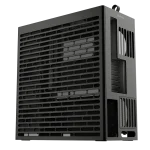
HAVN's HS 360 cases have gone global, with prices starting at $199.99 for the base model and $279.99 for the VGPU edition. Both mid-tower cases put the graphics card on display through a large curved glass panel. Buyers in China had seen the base case hit stores earlier, but the wider launch brings both versions to more markets.
The big choice here is how the graphics card sits. A standard HS 360 mounts it flat, while the VGPU kit lets builders stand it upright. That extra $80 gets them a height-adjustable bracket and a PCIe 5.0 x16 riser cable. The mount fits cards from 1.8 to four slots thick.
As for size, each case measures 490.9 × 242.1 × 520.9 mm. HAVN says the new design takes up 19.4% less room and weighs 29.5% less than its HS 420. It also claims a 36% gain in frame strength. Those are brand figures, though, not results from outside tests.
Airflow gets a neat bit of kit as well. A magnetic panel above the GPU helps send cool air at the card while keeping hot exhaust from going back through it. HAVN says this setup can cut GPU heat by as much as 6°C. But that claim may vary with the card, fans, and room heat.
For GPU fit, the base case has space for cards as long as 453mm. The upright mount cuts that limit to 433mm. Both versions work with ATX, Micro-ATX, and Mini-ITX boards, along with back-connect ATX models that help hide cables.
Cooling options are quite broad. Each chassis can take as many as eleven 120mm fans, while radiator fit tops out at 360mm on the base unit and 420mm on the VGPU. Tower coolers can reach 175mm in height, and PSU support covers ATX, SFX, and SFX-L types.
Other bits include an eight-port PWM fan hub, dust screens that pop out for cleaning, and a front panel with USB-C, two USB-A ports, audio, and power and reset controls. The VGPU also has room for four 3.5-inch drives or eight 2.5-inch units near its side fan area, with more mounts on its cable tray.
Still, builders will have to plan the layout with care. Thick GPUs, tall RAM, and large radiators may affect where each part can fit. And the vertical card setup may call for more care than a basic horizontal build.
At $80 more, the VGPU is mainly for buyers who want their graphics card on full display and need the extra mounting parts. The base HS 360 keeps much of the same look for less cash. Independent tests will have to show how well the cooling and stronger frame claims hold up.