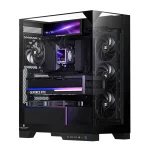
A dual-chamber PC case separates the motherboard and graphics-card area from the power supply, drives, and much of the cable clutter. The second compartment usually sits behind or beside the motherboard tray, giving builders a deeper routing area without filling the visible chamber with PSU leads and storage hardware.
The Thermalright TR-A30 ARGB and TR-A30 Vision cases use a stepped dual-chamber layout while keeping the main hardware on display behind glass. The useful part is not the glass itself. Separating bulky hardware creates different options for cable routing, fan placement, radiator mounting, and drive storage.
Comparing a dual-chamber PC case vs. a normal tower is mainly about how each enclosure spends its internal volume. The ASUS A32 dual-chamber layout puts the motherboard, CPU, and GPU in one section while storage devices and the power supply sit in another, which is the basic arrangement behind the term.
Power-supply placement also changes the shape of a dual-chamber case. A conventional tower normally puts the PSU below the motherboard, while many split layouts move it behind the board. The wider dual-chamber PC case size can therefore matter more than its height if your desk or shelf has limited room.
Extra space does not guarantee compatibility with hidden-connector motherboards. A back-connect board still needs correctly positioned openings in the tray and enough rear clearance for plugs and cable bends. The View 590 rear-connector layout illustrates the distinction because ordinary motherboard support and rear-connector support are separate specifications.
For a dual-chamber PC case fan setup, bottom or side intake paired with top and rear exhaust is common. The TUF GT502 Horizon cooling layout shows why removing the PSU from the floor area can free space for more fans and radiator hardware. Extra mounts help only when their direction and surrounding vents create a coherent flow.
A dual-chamber PC case with front fans is less common among panoramic designs because glass often occupies the front face. Side intake can replace that route, while bottom intake can feed the graphics card directly. Using an air cooler in a dual-chamber case is fine too, provided the cooler fits and its exhaust has a clear route toward the rear or roof.
Radiators complicate the picture slightly. A side radiator configured as intake sends some warmed air into the main chamber, while a roof radiator used as exhaust receives air already warmed by the graphics card. Neither arrangement is automatically poor. The same principles behind case airflow and positive pressure still matter more than the number of chambers.
Dust filters in a dual-chamber PC case also need breathing room. Placing a filtered bottom intake directly against thick carpet can choke the route intended to feed the GPU. The practical pros and cons of a dual-chamber PC case are physical: easier routing and flexible cooling on one side, then extra width, more panels, and potentially more fans to clean on the other.
The Light Base 900 FX rear-connector support combines backside motherboard connections with large radiator capacity, fan hubs, and removable dust filters. It is a useful reminder that a single vs dual chamber PC case decision should come down to the hardware you need to fit and service, not how much glass surrounds it.
A compact dual-chamber PC case can still make sense, but splitting a smaller enclosure leaves less tolerance around GPU thickness, PSU depth, radiator thickness, and cable bends. A dual-chamber PC case is worth it when the second compartment makes assembly cleaner or unlocks useful mounting space. If a normal tower already fits your hardware, routes your cables comfortably, and provides good airflow, adding another chamber solves very little.
The Thermalright TR-A30 ARGB and TR-A30 Vision cases use a stepped dual-chamber layout while keeping the main hardware on display behind glass. The useful part is not the glass itself. Separating bulky hardware creates different options for cable routing, fan placement, radiator mounting, and drive storage.
Comparing a dual-chamber PC case vs. a normal tower is mainly about how each enclosure spends its internal volume. The ASUS A32 dual-chamber layout puts the motherboard, CPU, and GPU in one section while storage devices and the power supply sit in another, which is the basic arrangement behind the term.
The second chamber buys routing space
Cable management in a dual-chamber PC case is usually the most obvious benefit during a build. Moving the PSU, spare cable length, drive mounts, fan hubs, and lighting controllers into the rear compartment gives thick leads somewhere to go without being pressed against the glass side of the system.Power-supply placement also changes the shape of a dual-chamber case. A conventional tower normally puts the PSU below the motherboard, while many split layouts move it behind the board. The wider dual-chamber PC case size can therefore matter more than its height if your desk or shelf has limited room.
Extra space does not guarantee compatibility with hidden-connector motherboards. A back-connect board still needs correctly positioned openings in the tray and enough rear clearance for plugs and cable bends. The View 590 rear-connector layout illustrates the distinction because ordinary motherboard support and rear-connector support are separate specifications.
Airflow still depends on the actual fan path
Airflow in a dual-chamber PC case can be excellent, but the chamber split does not automatically cool the CPU or GPU better. Both major heat sources normally remain together in the main compartment. Temperatures still depend on how easily fresh air reaches them and how efficiently heated air leaves the case.For a dual-chamber PC case fan setup, bottom or side intake paired with top and rear exhaust is common. The TUF GT502 Horizon cooling layout shows why removing the PSU from the floor area can free space for more fans and radiator hardware. Extra mounts help only when their direction and surrounding vents create a coherent flow.
A dual-chamber PC case with front fans is less common among panoramic designs because glass often occupies the front face. Side intake can replace that route, while bottom intake can feed the graphics card directly. Using an air cooler in a dual-chamber case is fine too, provided the cooler fits and its exhaust has a clear route toward the rear or roof.
Radiators complicate the picture slightly. A side radiator configured as intake sends some warmed air into the main chamber, while a roof radiator used as exhaust receives air already warmed by the graphics card. Neither arrangement is automatically poor. The same principles behind case airflow and positive pressure still matter more than the number of chambers.
Dust filters in a dual-chamber PC case also need breathing room. Placing a filtered bottom intake directly against thick carpet can choke the route intended to feed the GPU. The practical pros and cons of a dual-chamber PC case are physical: easier routing and flexible cooling on one side, then extra width, more panels, and potentially more fans to clean on the other.
The layout is useful when the space earns its keep
A dual-chamber PC case is better for builds that actually use the hidden volume. Several fan controllers, RGB hubs, multiple drives, thick modular PSU cables, large radiators, or rear-connector motherboards can turn the second compartment into working space instead of dead space.The Light Base 900 FX rear-connector support combines backside motherboard connections with large radiator capacity, fan hubs, and removable dust filters. It is a useful reminder that a single vs dual chamber PC case decision should come down to the hardware you need to fit and service, not how much glass surrounds it.
A compact dual-chamber PC case can still make sense, but splitting a smaller enclosure leaves less tolerance around GPU thickness, PSU depth, radiator thickness, and cable bends. A dual-chamber PC case is worth it when the second compartment makes assembly cleaner or unlocks useful mounting space. If a normal tower already fits your hardware, routes your cables comfortably, and provides good airflow, adding another chamber solves very little.