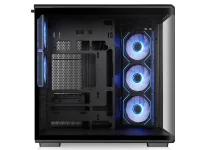
Thermaltake’s View 590 TG ARGB costs ¥2,000 more than the Arcus 380 TG ARGB in Japan for either color. Both arrive there on September 18, 2026, and both target the same panoramic, dual-chamber kind of build.
At first glance, the View 590 looks like a slightly enlarged Arcus 380. It is only 5 mm wider and 4 mm taller, while both cases are 477 mm deep, so the decision is not really about desk space.
The meaningful differences sit inside. The View 590’s broader hardware compatibility adds SSI-CEB support, more storage positions, a little more CPU-cooler clearance, and a side radiator mount that the Arcus 380 does not offer.
Rear-connector support is effectively tied. Both cases list ATX and microATX compatibility for back-connect designs from the current hidden-cable ecosystems, so paying more for the View 590 does not buy a broader rear-connector form-factor range.
CPU air-cooler clearance moves from 160 mm in the Arcus 380 to 165 mm in the View 590. Five millimeters sounds trivial until your chosen tower cooler sits at 162 or 163 mm, where the cheaper case simply falls outside its published allowance.
GPU clearance is closer. The Arcus 380 allows cards up to 430 mm, while the View 590 stretches the normal limit to 435 mm, a difference too small to matter for most graphics cards unless you are already shopping at the end of the market.
Storage separates them more sharply. The Arcus 380 lists one shared 3.5/2.5-inch position plus two dedicated 2.5-inch positions, while the View 590 adds two dedicated 3.5-inch positions alongside its shared bay and two 2.5-inch mounts.
PSU room follows the same pattern. The View 590 permits up to 270 mm without its HDD cage and 180 mm with the cage installed, while the Arcus 380 specifies a 180 to 260 mm range depending on drive placement.
Their fan layouts are nearly twins as well. Three 120 mm fans fit on the right side, three more can sit at the bottom, the roof takes three 120 mm or two 140 mm units, and two 120 mm positions sit at the rear.
Thermaltake also ships both with three reverse 120 mm fans on the right and two conventional 120 mm fans at the rear. The underlying dual-chamber airflow concept separates component zones so cooling and cable placement can be managed with less interference between them.
Arcus 380 buyers therefore give up surprisingly little in a conventional ATX gaming build. A 160 mm-or-shorter air cooler, one or two SSDs, a top-mounted AIO, and a large GPU all fit within the cheaper model’s stated design envelope without needing the View 590’s extra provisions.
The weight figures are unexpectedly reversed. The slightly larger View 590 is listed at about 8.8 kg, while the Arcus 380 comes in around 9.57 kg, although those numbers alone do not tell you anything useful about durability or panel quality.
Extra flexibility comes with a catch. Installing a side radiator in the View 590 drops its GPU clearance from 435 mm to 350 mm, so using the feature that most clearly distinguishes the case can remove 85 mm of graphics-card space.
No equivalent penalty appears in the Arcus 380 specification because it has no side radiator mount. A builder using a 360 mm top AIO can keep the Arcus model’s full 430 mm GPU allowance, which makes its simpler cooling layout quite sensible for an oversized graphics card.
The ¥2,000 Japanese price gap is therefore paying for options rather than a large jump in basic capacity. View 590 makes more sense when SSI-CEB, extra hard-drive positions, a taller air cooler, longer PSU clearance, or side-mounted liquid cooling solves a real requirement in your parts list.
Arcus 380 makes the cleaner case for a mainstream ATX showcase build that needs none of those extras. Its 430 mm GPU allowance, five included fans, hidden-connector support, and 360 mm roof radiator capacity already cover a broad high-end gaming configuration without paying for expansion room you may never use.
At first glance, the View 590 looks like a slightly enlarged Arcus 380. It is only 5 mm wider and 4 mm taller, while both cases are 477 mm deep, so the decision is not really about desk space.
The meaningful differences sit inside. The View 590’s broader hardware compatibility adds SSI-CEB support, more storage positions, a little more CPU-cooler clearance, and a side radiator mount that the Arcus 380 does not offer.
The View 590 earns its premium through flexibility
Standard motherboard support is the clearest divider. The Arcus 380 accepts ATX, microATX, and Mini-ITX boards, while the View 590 adds SSI-CEB for builders using a wider workstation-oriented motherboard.Rear-connector support is effectively tied. Both cases list ATX and microATX compatibility for back-connect designs from the current hidden-cable ecosystems, so paying more for the View 590 does not buy a broader rear-connector form-factor range.
CPU air-cooler clearance moves from 160 mm in the Arcus 380 to 165 mm in the View 590. Five millimeters sounds trivial until your chosen tower cooler sits at 162 or 163 mm, where the cheaper case simply falls outside its published allowance.
GPU clearance is closer. The Arcus 380 allows cards up to 430 mm, while the View 590 stretches the normal limit to 435 mm, a difference too small to matter for most graphics cards unless you are already shopping at the end of the market.
Storage separates them more sharply. The Arcus 380 lists one shared 3.5/2.5-inch position plus two dedicated 2.5-inch positions, while the View 590 adds two dedicated 3.5-inch positions alongside its shared bay and two 2.5-inch mounts.
PSU room follows the same pattern. The View 590 permits up to 270 mm without its HDD cage and 180 mm with the cage installed, while the Arcus 380 specifies a 180 to 260 mm range depending on drive placement.
The Arcus 380 keeps mainstream builds simpler
Both cases already cover the hardware most gaming PCs use. Each takes ATX boards, seven expansion slots, five preinstalled 120 mm ARGB fans, a 360 mm top radiator, and enough unrestricted GPU length for almost any current consumer card.Their fan layouts are nearly twins as well. Three 120 mm fans fit on the right side, three more can sit at the bottom, the roof takes three 120 mm or two 140 mm units, and two 120 mm positions sit at the rear.
Thermaltake also ships both with three reverse 120 mm fans on the right and two conventional 120 mm fans at the rear. The underlying dual-chamber airflow concept separates component zones so cooling and cable placement can be managed with less interference between them.
Arcus 380 buyers therefore give up surprisingly little in a conventional ATX gaming build. A 160 mm-or-shorter air cooler, one or two SSDs, a top-mounted AIO, and a large GPU all fit within the cheaper model’s stated design envelope without needing the View 590’s extra provisions.
The weight figures are unexpectedly reversed. The slightly larger View 590 is listed at about 8.8 kg, while the Arcus 380 comes in around 9.57 kg, although those numbers alone do not tell you anything useful about durability or panel quality.
Side radiator support creates the biggest split
The View 590 accepts a 360, 240, or 120 mm radiator on the side in addition to its roof and rear options. Arcus 380 radiator support is limited to the top and rear, even though both cases provide the same three side fan positions.Extra flexibility comes with a catch. Installing a side radiator in the View 590 drops its GPU clearance from 435 mm to 350 mm, so using the feature that most clearly distinguishes the case can remove 85 mm of graphics-card space.
No equivalent penalty appears in the Arcus 380 specification because it has no side radiator mount. A builder using a 360 mm top AIO can keep the Arcus model’s full 430 mm GPU allowance, which makes its simpler cooling layout quite sensible for an oversized graphics card.
The ¥2,000 Japanese price gap is therefore paying for options rather than a large jump in basic capacity. View 590 makes more sense when SSI-CEB, extra hard-drive positions, a taller air cooler, longer PSU clearance, or side-mounted liquid cooling solves a real requirement in your parts list.
Arcus 380 makes the cleaner case for a mainstream ATX showcase build that needs none of those extras. Its 430 mm GPU allowance, five included fans, hidden-connector support, and 360 mm roof radiator capacity already cover a broad high-end gaming configuration without paying for expansion room you may never use.