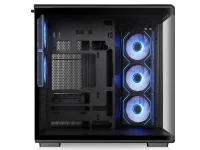
Thermaltake rates the View 590 TG ARGB for graphics cards up to 435 mm long, but a side radiator cuts that limit to 350 mm. The headline clearance is generous, yet it only applies when the side radiator position stays empty.
A builder can miss this detail because the case also accepts a 360 mm radiator on the top. The two mounting positions are not equivalent once a long graphics card enters the parts list, and choosing the side mount first can quietly rule out some of the largest air-cooled cards.
The useful way to read the View 590 TG ARGB side-radiator layout is as two different GPU envelopes. One gives you 435 mm of card length, while the other stops at 350 mm before cable routing and installation tolerance even enter the conversation.
Nothing about the GPU itself has to be exotic for the conflict to appear. Modern flagship coolers often stretch well beyond 350 mm, and board partners build around their own heatsinks, fan layouts, and shrouds instead of following one fixed card length.
AIO cooling still depends on a radiator-and-fan cooling layout that places a heat exchanger and airflow hardware somewhere inside or around the chassis. In the View 590, putting that hardware on the side is convenient for cooling, but the trade-off is physical room in front of a long card.
Top mounting changes the calculation. Thermaltake lists support for a 360 mm radiator on the top as well, while the reduced 350 mm GPU figure is specifically attached to side-radiator installation, so a top-mounted CPU AIO avoids that particular length penalty.
The stock fan arrangement does not force you into the side radiator either. The case ships with three reverse 120 mm fans on the right side and two 120 mm rear fans, so moving CPU liquid cooling to the roof does not leave the chassis bare.
Large partner cards tell a different story. ASUS lists the ROG Astral RTX 5090 at 357.6 mm, MSI lists the air-cooled RTX 5090 Suprim at 359 mm, and Gigabyte's AORUS RTX 5090 Master reaches 360 mm.
All three exceed the View 590's stated 350 mm limit with a side radiator installed. The misses are small enough to tempt an optimistic builder, but a specification limit is not a target for squeezing hardware against a radiator, fan frame, hose fitting, or cable.
The unrestricted 435 mm figure gives those cards far more breathing room. An ASUS Astral at 357.6 mm leaves more than 77 mm against the published maximum, while the 360 mm AORUS still leaves 75 mm when the side radiator is absent.
Card length also tells only part of the fit story. Thick RTX 5090 models can occupy close to four slots, and tall coolers push the 16-pin connector toward the glass, so the final test fit needs to include cable bend space rather than treating millimeters of length as the whole answer.
A side-mounted radiator still makes sense with shorter cards. The 304 mm RTX 5090 Founders Edition leaves 46 mm against the stated side-radiator GPU limit, and many smaller RTX 5080, RTX 5070 Ti, Radeon, or workstation cards can leave considerably more room.
Avoid planning from GPU family names alone. A "5090" can be 304 mm, 357.6 mm, 359 mm, or 360 mm depending on the exact model, so the manufacturer's card dimensions matter more than the chip name printed on the box.
Measure the complete build before committing to the radiator screws. Check the exact card length, confirm where the radiator and fans sit, allow room for the GPU power lead, and route the AIO tubes without forcing them into the card shroud or rear fan area.
A builder can miss this detail because the case also accepts a 360 mm radiator on the top. The two mounting positions are not equivalent once a long graphics card enters the parts list, and choosing the side mount first can quietly rule out some of the largest air-cooled cards.
The useful way to read the View 590 TG ARGB side-radiator layout is as two different GPU envelopes. One gives you 435 mm of card length, while the other stops at 350 mm before cable routing and installation tolerance even enter the conversation.
A side radiator cuts 85 mm from GPU clearance
A 360 mm side-mounted AIO takes space from the same region used by an extra-long graphics card. Thermaltake therefore lowers the supported GPU length by 85 mm when a radiator occupies that position, which is a meaningful chunk of room rather than a small technical footnote.Nothing about the GPU itself has to be exotic for the conflict to appear. Modern flagship coolers often stretch well beyond 350 mm, and board partners build around their own heatsinks, fan layouts, and shrouds instead of following one fixed card length.
AIO cooling still depends on a radiator-and-fan cooling layout that places a heat exchanger and airflow hardware somewhere inside or around the chassis. In the View 590, putting that hardware on the side is convenient for cooling, but the trade-off is physical room in front of a long card.
Top mounting changes the calculation. Thermaltake lists support for a 360 mm radiator on the top as well, while the reduced 350 mm GPU figure is specifically attached to side-radiator installation, so a top-mounted CPU AIO avoids that particular length penalty.
The stock fan arrangement does not force you into the side radiator either. The case ships with three reverse 120 mm fans on the right side and two 120 mm rear fans, so moving CPU liquid cooling to the roof does not leave the chassis bare.
Several flagship RTX 5090 cards miss the 350 mm limit
NVIDIA's RTX 5090 Founders Edition is 304 mm long, so it sits comfortably inside the 350 mm side-radiator limit on paper. You still need to account for the power connection, and NVIDIA advises leaving another 36 mm for the cable when preparing a case for the Founders Edition.Large partner cards tell a different story. ASUS lists the ROG Astral RTX 5090 at 357.6 mm, MSI lists the air-cooled RTX 5090 Suprim at 359 mm, and Gigabyte's AORUS RTX 5090 Master reaches 360 mm.
All three exceed the View 590's stated 350 mm limit with a side radiator installed. The misses are small enough to tempt an optimistic builder, but a specification limit is not a target for squeezing hardware against a radiator, fan frame, hose fitting, or cable.
The unrestricted 435 mm figure gives those cards far more breathing room. An ASUS Astral at 357.6 mm leaves more than 77 mm against the published maximum, while the 360 mm AORUS still leaves 75 mm when the side radiator is absent.
Card length also tells only part of the fit story. Thick RTX 5090 models can occupy close to four slots, and tall coolers push the 16-pin connector toward the glass, so the final test fit needs to include cable bend space rather than treating millimeters of length as the whole answer.
Top mounting keeps the larger GPU envelope intact
For a build centered on an oversized air-cooled GPU, the top radiator position is the cleaner starting point. It lets you use the case's larger published graphics-card allowance without sacrificing the 360 mm CPU radiator class.A side-mounted radiator still makes sense with shorter cards. The 304 mm RTX 5090 Founders Edition leaves 46 mm against the stated side-radiator GPU limit, and many smaller RTX 5080, RTX 5070 Ti, Radeon, or workstation cards can leave considerably more room.
Avoid planning from GPU family names alone. A "5090" can be 304 mm, 357.6 mm, 359 mm, or 360 mm depending on the exact model, so the manufacturer's card dimensions matter more than the chip name printed on the box.
Measure the complete build before committing to the radiator screws. Check the exact card length, confirm where the radiator and fans sit, allow room for the GPU power lead, and route the AIO tubes without forcing them into the card shroud or rear fan area.