Intel just waved a glass-based monster package at the industry, basically saying the glass substrate rumors were wildly premature.
Intel shows it is not done with glass
Intel shows it is not done with glass
- Intel rolled up to NEPCON Japan with something loud.
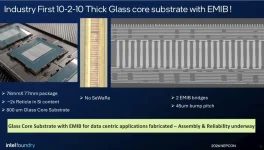
- The company showed off a thick glass substrate fused with EMIB.
- This is aimed straight at data center and HPC-class silicon.
- The demo came from Intel Foundry.
- It was presented at NEPCON Japan.
- Intel framed it as a first-of-its-kind implementation.
- Recent chatter said Intel had quietly backed off from glass substrates.
- That talk picked up after some key departures.
- This demo pretty much shuts that rumor down.
- The design combines EMIB with a thick glass core.
- The package size lands at 78 mm by 77 mm.
- Intel says this enables a two-times reticle-scale design.
- Translation: this thing is built for huge silicon assemblies.
- The structure follows a 10-2-10 layout.
- Ten redistribution layers on top.
- A two-layer glass core in the middle.
- Ten build-up layers underneath.
- Even with all that density, wiring stays tight because glass behaves better than organic substrates.
- Intel already dropped two EMIB bridges into the package.
- Those bridges link multiple compute dies.
- This is clearly a multi-chiplet GPU-style configuration.
- The footprint screams server hardware.
- The No SeWaRe label points to data center deployments.
- Think AI accelerators and HPC silicon, not consumer CPUs.
- Glass allows finer interconnects.
- Depth-of-field control improves.
- Mechanical stress drops compared to organic substrates.
- All of that helps when you want absurdly large chiplet counts.
- EMIB is getting a lot of attention in HPC circles.
- Advanced packaging supply chains are tight right now.
- Intel is leaning hard into this opening.
- Advanced packaging is shaping up as a revenue angle.
- Intel Foundry clearly wants in on that.
- Glass substrates paired with EMIB look like a long-term bet, not a side project.
- Intel did not shelve glass substrates.
- It doubled down and brought receipts.
- If AI chips keep growing sideways instead of up, this kind of packaging is where the fight moves next.