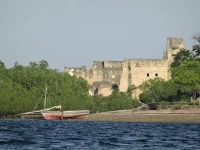
Tanzania's historic Kilwa Kisiwani island serves as a designated World Heritage Site while supporting approximately 1,150 residents who maintain traditional economic activities including cultural tourism, fishing and subsistence farming. The archaeological location once functioned as the center of the medieval Kilwa Sultanate, with the settlement reaching populations exceeding 10,000 inhabitants during its commercial peak across the 13th through 15th centuries, when trade networks extended along the entire Swahili Coast.
Recent genetic analysis of remains from coastal communities revealed that medieval populations carried predominantly African maternal ancestry combined with Persian paternal lineage, with mixing patterns beginning around 1000. The 12-square-kilometer island contains notable architectural remnants including the Great Mosque with its distinctive hexagonal columns and the Palace of Husuni Kubwa, an early 14th-century complex featuring over one hundred rooms and an octagonal pool overlooking the Indian Ocean.
Conservation efforts continue addressing deterioration from erosion and vegetation growth affecting structures like the palace's eastern sections, which face progressive collapse near cliff edges according to preservation assessments.
Recent genetic analysis of remains from coastal communities revealed that medieval populations carried predominantly African maternal ancestry combined with Persian paternal lineage, with mixing patterns beginning around 1000. The 12-square-kilometer island contains notable architectural remnants including the Great Mosque with its distinctive hexagonal columns and the Palace of Husuni Kubwa, an early 14th-century complex featuring over one hundred rooms and an octagonal pool overlooking the Indian Ocean.
Conservation efforts continue addressing deterioration from erosion and vegetation growth affecting structures like the palace's eastern sections, which face progressive collapse near cliff edges according to preservation assessments.