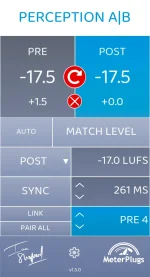
Perception AB can automatically detect up to 3000 milliseconds of delay between its Pre and Post instances before manual correction is required. The number is generous because an honest comparison depends on timing as well as loudness. Two states can be level matched perfectly and still produce a useless switch if they land at different moments.
A mistimed toggle often announces itself with a click, stutter, repeated transient, or tiny leap in the groove. More subtle errors are worse because nothing sounds obviously broken. You may end up judging two different slices of the performance and crediting the processor for a change caused by timing.
A clean latency-compensated Perception AB comparison keeps the Pre and Post streams aligned before you decide whether an EQ, compressor, limiter, or hardware chain actually improved anything. Level matching removes one bias. Synchronization removes a different one.
Look-ahead limiters, linear-phase processors, oversampling modes, and other latency-heavy tools can push the Post path later than the Pre path. Adding or removing a plug-in can change the total delay, so a sync value measured ten minutes ago may no longer describe the chain in front of you. Re-syncing after a structural change is not housekeeping. It is part of the comparison.
Fast switching also protects your memory of timbre. Performance on complex-tone timbre discrimination is better across short retention intervals than long ones in work on short-term auditory memory for timbre, which matters when the difference you are chasing is a small shift in texture or spectral balance. A click or timing jump inserts another event between the two versions and makes the judgment harder than it needs to be.
Perception AB can include D/A and A/D conversion delay when it calculates synchronization between Pre and Post. If automatic detection struggles, its Sync Time value can be entered manually. This is useful when a processor interferes with detection or when you already have a measured hardware insert offset from the DAW.
Manual correction should come from a repeatable measurement, not from dragging a value until the switch feels smoother. A short transient or tone with a clear start gives you an obvious timing reference when measuring an external loop. Once the returned signal lines up, the A/B switch stops comparing the hardware path against a slightly displaced copy of the source.
Lowering the audio-interface buffer is not a substitute for this correction. Buffer size changes monitoring responsiveness and system load, while a hardware round trip or a processor with deliberate look-ahead can still add its own delay. Chasing a smaller buffer can leave the actual comparison error untouched.
Some changes deserve extra suspicion because they alter processing architecture rather than just tone. Switching a processor into a higher-latency mode, inserting a linear-phase stage, adding external hardware, or moving the Post instance can all change what sits between the comparison points. Check the timing again before trusting a close call.
Listen for the switch itself before listening for sonic improvement. A good A/B transition should preserve the musical moment, with no doubled attack, missing syllable, displaced kick, or rhythmic hiccup pulling your attention away from the processing. If the transition calls attention to itself, fix the timing first.
Once timing and loudness are both controlled, small processing differences become much easier to judge on their own terms. A half-decibel tonal move, a softer limiter release, or a cleaner transient no longer has to compete with a level jump or a shifted beat. The comparison becomes boring in exactly the right way.
A mistimed toggle often announces itself with a click, stutter, repeated transient, or tiny leap in the groove. More subtle errors are worse because nothing sounds obviously broken. You may end up judging two different slices of the performance and crediting the processor for a change caused by timing.
A clean latency-compensated Perception AB comparison keeps the Pre and Post streams aligned before you decide whether an EQ, compressor, limiter, or hardware chain actually improved anything. Level matching removes one bias. Synchronization removes a different one.
Host delay compensation is not the whole fix
DAW plugin delay compensation keeps tracks aligned by accounting for latency reported by plug-ins. It is essential, but it solves a broader session-timing problem rather than guaranteeing a seamless comparison between two monitoring states. Perception AB measures the delay between its own Pre and Post points, which can include the processors sitting between them.Look-ahead limiters, linear-phase processors, oversampling modes, and other latency-heavy tools can push the Post path later than the Pre path. Adding or removing a plug-in can change the total delay, so a sync value measured ten minutes ago may no longer describe the chain in front of you. Re-syncing after a structural change is not housekeeping. It is part of the comparison.
Fast switching also protects your memory of timbre. Performance on complex-tone timbre discrimination is better across short retention intervals than long ones in work on short-term auditory memory for timbre, which matters when the difference you are chasing is a small shift in texture or spectral balance. A click or timing jump inserts another event between the two versions and makes the judgment harder than it needs to be.
Hardware loops expose hidden round-trip delay
External analog gear adds a second timing problem because audio has to leave the DAW, pass through conversion and hardware, then return through another conversion stage. The host can compensate accurately only when it knows the real round-trip delay. A converter path, digital processor, or hardware insert can therefore require measurement rather than assumption.Perception AB can include D/A and A/D conversion delay when it calculates synchronization between Pre and Post. If automatic detection struggles, its Sync Time value can be entered manually. This is useful when a processor interferes with detection or when you already have a measured hardware insert offset from the DAW.
Manual correction should come from a repeatable measurement, not from dragging a value until the switch feels smoother. A short transient or tone with a clear start gives you an obvious timing reference when measuring an external loop. Once the returned signal lines up, the A/B switch stops comparing the hardware path against a slightly displaced copy of the source.
Lowering the audio-interface buffer is not a substitute for this correction. Buffer size changes monitoring responsiveness and system load, while a hardware round trip or a processor with deliberate look-ahead can still add its own delay. Chasing a smaller buffer can leave the actual comparison error untouched.
Re-sync after the processing chain changes
The most common failure is simple. You sync the comparison, add another processor, change the chain, and carry on listening as if the original timing value still applies. Perception AB specifically requires another sync when the latency between Pre and Post changes.Some changes deserve extra suspicion because they alter processing architecture rather than just tone. Switching a processor into a higher-latency mode, inserting a linear-phase stage, adding external hardware, or moving the Post instance can all change what sits between the comparison points. Check the timing again before trusting a close call.
Listen for the switch itself before listening for sonic improvement. A good A/B transition should preserve the musical moment, with no doubled attack, missing syllable, displaced kick, or rhythmic hiccup pulling your attention away from the processing. If the transition calls attention to itself, fix the timing first.
Once timing and loudness are both controlled, small processing differences become much easier to judge on their own terms. A half-decibel tonal move, a softer limiter release, or a cleaner transient no longer has to compete with a level jump or a shifted beat. The comparison becomes boring in exactly the right way.