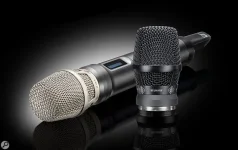
Neumann’s KK 104 A and KK 105 A replace the KK 204 and KK 205 with lower handling noise and updated Sennheiser compatibility. The basic choice still works the same way, with the 104 family using cardioid pickup and the 105 family using supercardioid pickup.
So this is not a clean-sheet change where the older capsules suddenly became irrelevant. The new Neumann wireless capsule heads keep the same KMS-derived true-condenser idea that defined the KK 204 and KK 205, while Neumann has concentrated the A-series changes around handling, packaging, headroom, noise performance, and newer transmitter support.
Frequency response stays at 40 Hz to 20 kHz across both generations, and the fixed low-cut approach is still there for close vocal work. Pop protection, moisture control, hardened grilles, and condenser capsule technology also carry over. Anyone expecting the KK 104 A to sound like a completely different microphone from the KK 204 is probably looking at the wrong part of the upgrade.
One spec change is easy to miss. Neumann lists strongest rearward rejection at 120 degrees for the KK 205 and 135 degrees for the KK 105 A, while cardioid stays at 180 degrees on the 104 side. Engineers copying an old monitor layout should verify the new polar pattern instead of assuming every rejection angle carried over untouched.
Neumann also describes both new capsules as using the same capsule technology found in its wired KMS stage microphones. The older KK 204 and KK 205 were already built around the KMS line, which matters because it puts the upgrade in context. You are buying a revised wireless head around a proven acoustic concept, not a replacement for everything Neumann was doing before.
The numbers move as well. The older KK 204 and KK 205 are rated at 150 dB maximum SPL, 24 dB-A equivalent noise, 70 dB-A signal-to-noise ratio, and 2.8 mV/Pa sensitivity. The KK 104 A and KK 105 A move to 154 dB maximum SPL, 20 dB-A equivalent noise, 74 dB signal-to-noise ratio, and 3 mV/Pa sensitivity.
None of those changes turn a good KK 205 into junk. They do show a quieter and slightly more capable front end on paper, with extra SPL margin for very loud close vocals and percussion-like vocal attacks. Neumann also shrank the new capsule bodies to a listed 48 mm diameter and 80 mm length, although the older product pages publish assembled transmitter dimensions rather than a clean capsule-only measurement, so a fake millimeter-for-millimeter comparison would be pointless.
The older KK 204 and KK 205 pages also list EW-D, but they include legacy SKM 2000 and EW G4 300/500 support that does not appear on Neumann’s current A-series compatibility list. Absence from the new list does not prove an old transmitter can never function with an A-series head, but it does mean you should not assume official support where Neumann has not listed it.
For somebody already happy with a KK 204 or KK 205 on an existing rig, the upgrade case is strongest when handling noise is actually getting into the show, the extra 4 dB of SPL margin matters, or the wireless system itself is moving toward Spectera or EW-DX. A singer staying on a stable older setup gets less obvious benefit, especially when the cardioid or supercardioid behavior they already like has not been reinvented.
So this is not a clean-sheet change where the older capsules suddenly became irrelevant. The new Neumann wireless capsule heads keep the same KMS-derived true-condenser idea that defined the KK 204 and KK 205, while Neumann has concentrated the A-series changes around handling, packaging, headroom, noise performance, and newer transmitter support.
The A-series keeps the familiar Neumann core
The KK 104 A remains the forgiving option for singers who move around the grille a lot. Its cardioid pattern rejects most strongly from the rear, while the KK 105 A keeps the tighter supercardioid behavior aimed at better separation on crowded stages. The older KK 204 and KK 205 followed the same cardioid and supercardioid split, so moving to the A-series does not change which polar pattern suits your stage.Frequency response stays at 40 Hz to 20 kHz across both generations, and the fixed low-cut approach is still there for close vocal work. Pop protection, moisture control, hardened grilles, and condenser capsule technology also carry over. Anyone expecting the KK 104 A to sound like a completely different microphone from the KK 204 is probably looking at the wrong part of the upgrade.
One spec change is easy to miss. Neumann lists strongest rearward rejection at 120 degrees for the KK 205 and 135 degrees for the KK 105 A, while cardioid stays at 180 degrees on the 104 side. Engineers copying an old monitor layout should verify the new polar pattern instead of assuming every rejection angle carried over untouched.
Neumann also describes both new capsules as using the same capsule technology found in its wired KMS stage microphones. The older KK 204 and KK 205 were already built around the KMS line, which matters because it puts the upgrade in context. You are buying a revised wireless head around a proven acoustic concept, not a replacement for everything Neumann was doing before.
Handling noise and headroom are the real upgrades
Neumann specifically calls out noticeably reduced handling noise on the KK 104 A and KK 105 A. On a handheld vocal mic, this is not trivia. Fingers shifting on the body, a singer swapping hands, or somebody gripping the transmitter harder can send mechanical energy toward the capsule, and handheld microphone handling-noise perception becomes audible once those unwanted events rise far enough against the wanted signal.The numbers move as well. The older KK 204 and KK 205 are rated at 150 dB maximum SPL, 24 dB-A equivalent noise, 70 dB-A signal-to-noise ratio, and 2.8 mV/Pa sensitivity. The KK 104 A and KK 105 A move to 154 dB maximum SPL, 20 dB-A equivalent noise, 74 dB signal-to-noise ratio, and 3 mV/Pa sensitivity.
None of those changes turn a good KK 205 into junk. They do show a quieter and slightly more capable front end on paper, with extra SPL margin for very loud close vocals and percussion-like vocal attacks. Neumann also shrank the new capsule bodies to a listed 48 mm diameter and 80 mm length, although the older product pages publish assembled transmitter dimensions rather than a clean capsule-only measurement, so a fake millimeter-for-millimeter comparison would be pointless.
New wireless compatibility changes the buying decision
System support may be the biggest practical reason to care. Neumann lists the KK 104 A and KK 105 A for Spectera, EW-D, EW-DX, and Digital 6000/9000 handheld transmitters. On Spectera, the SKM transmitter already supports both A-series capsules alongside the older KK 204 and KK 205.The older KK 204 and KK 205 pages also list EW-D, but they include legacy SKM 2000 and EW G4 300/500 support that does not appear on Neumann’s current A-series compatibility list. Absence from the new list does not prove an old transmitter can never function with an A-series head, but it does mean you should not assume official support where Neumann has not listed it.
For somebody already happy with a KK 204 or KK 205 on an existing rig, the upgrade case is strongest when handling noise is actually getting into the show, the extra 4 dB of SPL margin matters, or the wireless system itself is moving toward Spectera or EW-DX. A singer staying on a stable older setup gets less obvious benefit, especially when the cardioid or supercardioid behavior they already like has not been reinvented.